Wednesday, July 24, 2013

DAMMING THE OSAGE wins in two categories of ForeWord Reviews’ 15th annual Book of the Year Awards

ForeWord Reviews’ 15th annual Book of the Year Awards, judged by a select group of librarians and booksellers from around the country, were announced at the American Libraries Association Annual conference.

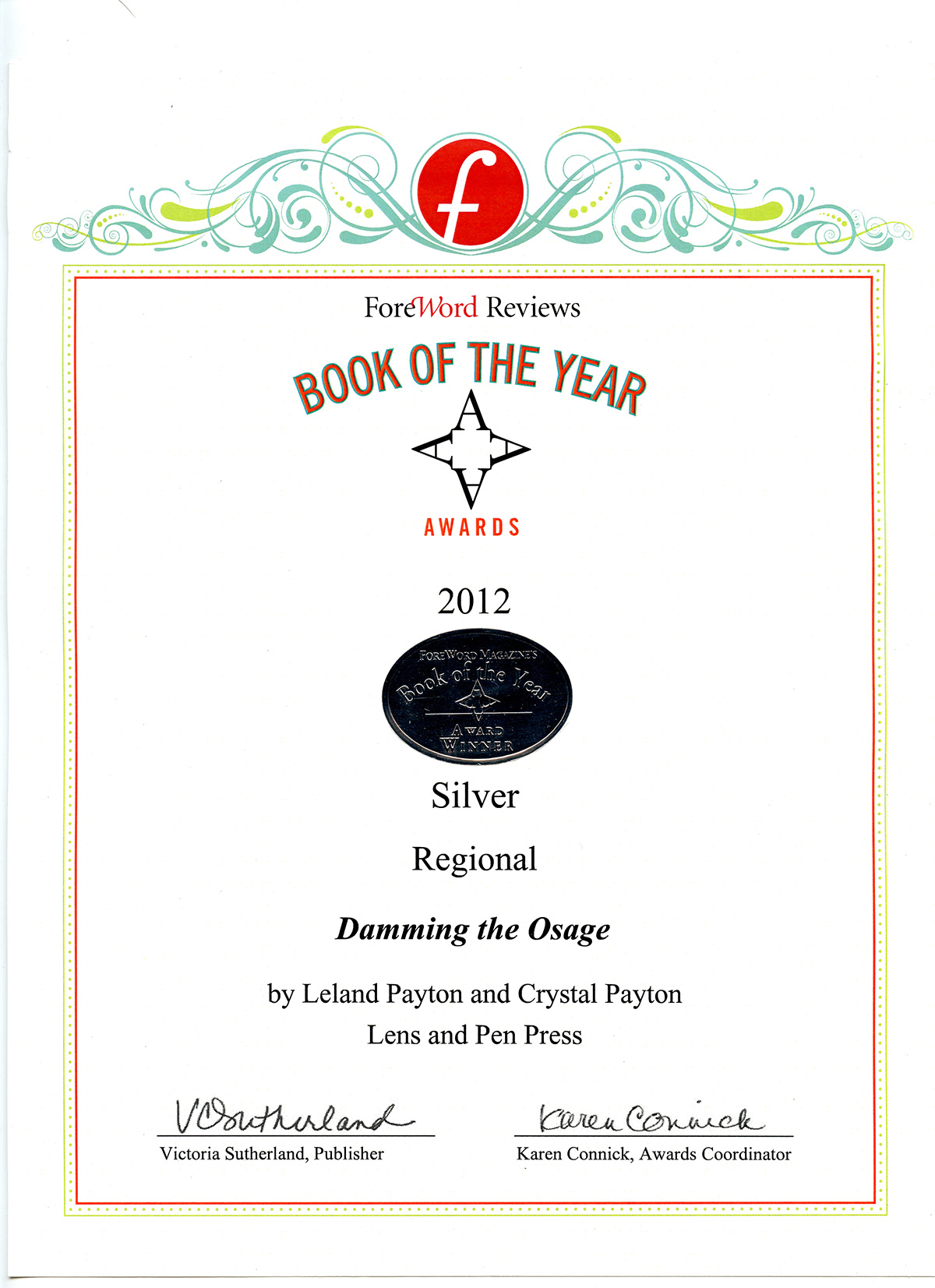
Damming the Osage: The Conflicted Story of Lake of the Ozarks and Truman Reservoir received two awards: silver in Regional Non-Fiction and bronze in the Ecology and the Environment category.foreword-award-large

With 1,300 entries from more than 600 publishers, 248 winners were selected in 62 categories.

Damming the Osage also won a silver medal in the Independent Publishers Books Awards (IPPY), Best Regional Non Fiction category.   Lens & Pen’s Crystal Payton received the award in New York City. The title continues to pull in positive reviews and comments on blogs and Web sites.

ForeWord Reviews, a quarterly print journal dedicated to reviewing independently published books, was established in 1998 to provide booksellers, librarians, agents, and publishing professionals with reviews of the best titles from small, alternative, and academic presses.


DAMMING THE OSAGE wins in two categories of ForeWord Reviews’ 15th annual Book of the Year Awards

Monday, July 8, 2013

Review of Damming the Osage in St. Louis Post Dispatch


This weekend the St. Louis Post Dispatch published a review of Damming the Osage. Written by Steve Weigenstein, author of Slant of Light, a historical novel set in the Civil War,  “Tangled History of Osage River” (find it here) is a concise, but encompassing, description.  When the reviewer really ‘gets’ what we are trying to do and the way we did it – it is rewarding!  I especially liked his final paragraph:


Like the Osage itself, this book meanders. Those desiring a more compact, straightforward narrative — a channelized book, so to speak — will be disappointed. But those willing to follow its twists and turns will find, like a river floater, surprises and pleasures around every bend.


After the review was published orders came in to amazon.com and they sold out of stock.  We’re hoping they reorder soon.  Of course, it’s still available through our Web site!


Review of Damming the Osage in St. Louis Post Dispatch

Friday, June 7, 2013

DAMMING THE OSAGE receives medal at 17th IPPY awards in New York

IMG_5941


It was a warm, humid late spring evening in New York City for the 17th annual Independent Publisher Book Awards. A festive crowd gathered for the ceremony, emceed by Jim Barnes. Crystal Payton, co-author of Damming the Osage represented Lens & Pen Press, picking up the silver medal for regional non-fiction, Mid-West.


IPPY-ATL_2419-2013-DTO


Crystal Payton with IPPY spokesperson Trey Gerrald


Award winning books covered a broad range of topics from the Royal Cavalry of Oman to poetry and pop-up books to – of course – the story of a prairie stream and the people who live on and with it. University presses, independent publishers, e-book producers and photographers brought a rich assortment of interests and entertainments to the event. Entries came from every U. S. state and several countries. This year the IPB received more than 5,300 entries, of which 382 received medals.


While not all medalists were able to attend the ceremony, all three winners in the non-fiction, Midwest region were there.


IPPY-award-2-1-DTO


Crystal Payton/Damming the Osage; Noppadol Paothong, photographer/Save the Last Dance (written by Joel Vance);

and Glen Ediger/Leave No Threshing Stone Unturned


DAMMING THE OSAGE receives medal at 17th IPPY awards in New York

Tuesday, May 21, 2013

DAMMING THE OSAGE AWARDED SILVER MEDAL IN NATIONAL COMPETITION

Lens & Pen Press’s newest title is their third book to receive IPPY recognition

SPRINGFIELD, Mo.Damming the Osage: The Conflicted Story of Lake of the Ozarks and Truman Reservoir, by Leland and Crystal Payton, has won a silver medal in Best Regional Non-Fiction Mid-West (which includes eight states) in the 2013 Independent Publishers Book Awards. Lens & Pen Press’s newest title is their third book to receive such recognition. Mystery of the Irish Wilderness in 2009 received a gold medal; See the Ozarks: The Touristic Image was an IPPY award finalist in 2004.

This respected competition is open to independent book producers, university presses, and divisions of major publishers that release 50 or fewer books a year. Chosen from a total of 5,300 entries, the 382 medalists represent 44 U.S. states plus the District of Columbia, five Canadian provinces, and eight countries overseas. Co-author Crystal Payton will receive the award at a ceremony on May 29th, in New York City.

Damming the Osage chronicles the untold story of crime, duplicity and deception in the conversion of a free flowing prairie stream into reservoirs.  Rising in Kansas’s Flint Hills, after gathering tributaries through prairie country, the Marais des Cygnes River enters Missouri and soon after becomes the Osage River. It cuts a meandering course through the northern Ozarks, before dumping into the Missouri River. It’s a big, turbid river with a turbulent history. Changes caused by massive water resource development have rarely been examined with a sharper focus and never better illustrated.

Reviews have focused on the exhaustive research (“stupendous” one reviewer called it and “impressive”) and remarkable capturing of the history of a river and the people who live with and on it. Outdoor writer Joel Vance called Damming the Osage a “first-class recital of the river’s history and the story of the two dams that swallowed most of it…a triumph of research and reporting.”

Damming The Osage (ISBN: 978-0-9673925-8-5) retails for $35. Available at many Barnes & Noble bookstores or through www.amazon.com Copies can also be ordered from the publisher, postage paid, at www.dammingtheosage.com

Downloadable images of the book cover and author photos are available at http://www.dammingtheosage.com/for-the-media/

For more information on this and other Lens & Pen books visit www.beautifulozarks.com or email lensandpen@yahoo.com .

Information on the 2013 IPPY awards can be found at: http://www.independentpublisher.com/article.php?page=1653


DAMMING THE OSAGE AWARDED SILVER MEDAL IN NATIONAL COMPETITION

Thursday, May 16, 2013

BRIDGE AT HOECKER / HENLEY (UNDER CONSTRUCTION) 1903

Henley RR bridge construction

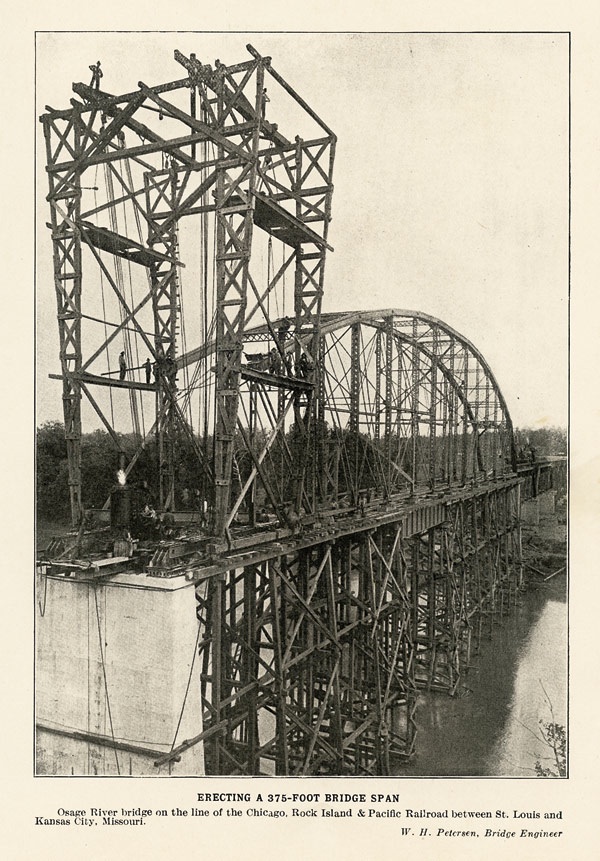
Although long out of service,  the Henley railroad bridge is still an imposing iron bridge across the Osage in Miller County, not far from St. Elizabeth. It is hard to get to as the right of way is grown up and interested bridge hunters have to walk in. Tangled, grown up brush makes the walk difficult – easier in winter than summer.

It was built in 1903 for the Chicago, Rock Island, & Pacific Railroad to span the Osage River. The main span is a pin-connected, 14-panel Pennsylvania through truss. With the bankruptcy of the railroad in 1980, ownership of the line was transferred through many hands until the Union Pacific Railroad sold it to Ameren Corp, a St. Louis-based utility.  The majority of the line (including the Henley Bridge) has not been used since 1979.

Bridgehunter.com is a valuable resource for those fascinated by old bridges.

Bridgehunter.com’s inventory of bridges and bridges lost on the Osage River:


Wednesday, May 15, 2013

BRICE SPRING - now Bennett Spring State Park on the Niangua River

Brice - log dam


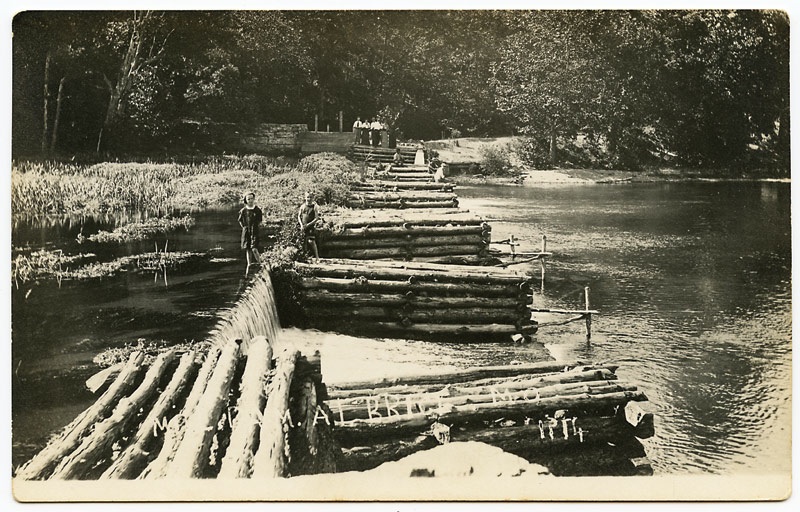
Real photo postcard – Mill Dam at Brice Mo, 1914


Given an abundant water source, like a spring-fed Ozark stream, one of the first things pioneers often did was build a water mill. The dams began as crude wood obstructions like the one seen here at Brice Springs – now called Bennett Springs, a Missouri state park. Once established and powering mills, owners then began to add stone and concrete to strengthen the small dams.


Among the first settlers on this branch flowing into the Niangua River was James Brice, who established his mill in 1846. Although several other mills were built here at different times, the most successful mill was operated by Peter Bennett, Brice’s son-in-law. Eventually, Bennett became the namesake for the spring, and later, the park.


The spring valley became a popular camping ground for farmers while waiting for their grain to be ground at the Bennett mill. To pass time, campers would fish, hunt and visit with local residents..


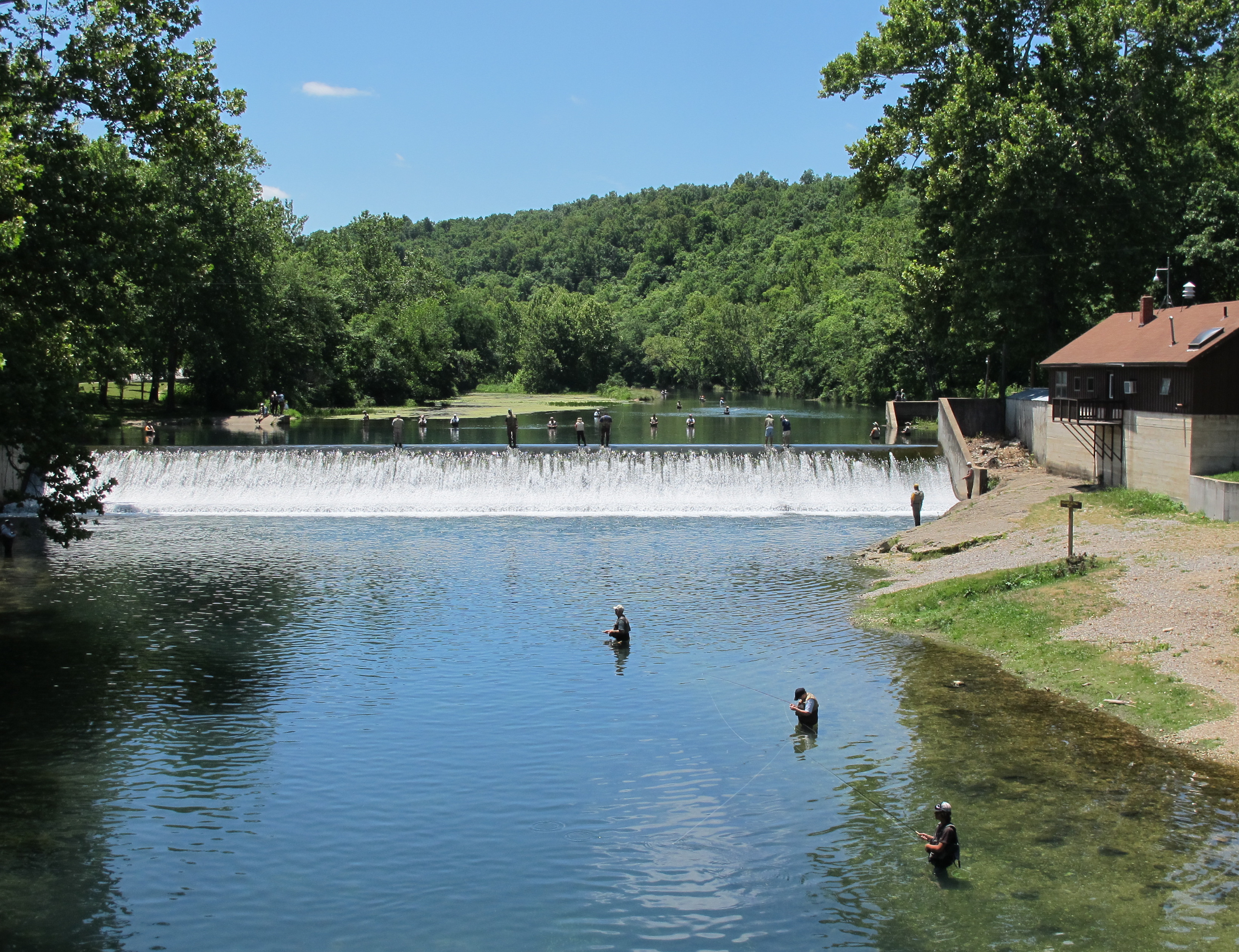
By the turn of the century, recreation was gaining in importance. Already a favorite spot among fishermen, in 1900 the Missouri Fish Commissioner introduced 40,000 mountain trout into the spring. A privately owned fish hatchery was built in 1923. In 1924, the state purchased the spring and part of the surrounding area to create one of the first state parks. The park is now owned and operated by the Missouri Department of Natural Resources; the Missouri Department of Conservation operates the trout hatchery.


While there is nothing left of the Brice Spring era, the park was extensively remodeled by WPA workers in the Adirondacks style in the 1930s. Today, Bennett Spring, which has a daily average flow of more than 100 million gallons, is one of Missouri’s most popular state parks.


IMG_2869


http://www.mostateparks.com/page/54086/general-information


Every week we post an unpublished image that relates to the Osage River, its ecology, history and development. None of these have been used in Damming the Osage, but they relate to the themes of the book. A brief caption identifies the location and our thoughts on its significance and meaning. Feel free to use these images for personal use if you credit “Collection of Leland and Crystal Payton.”  For commercial use, email us for details and a modest fee for a higher resolution image. We have thousands of historic photographs and brochures as well as our own contemporary photos.


If you have comments or additional information on these images please use the form below.


If you would like to receive email notifications of the Vintage Image of the Week, please provide us with your email.


BRICE SPRING - now Bennett Spring State Park on the Niangua River
Thursday, May 9, 2013

PLANS FOR LOCK AND DAM NO.1 ON OSAGE RIVER

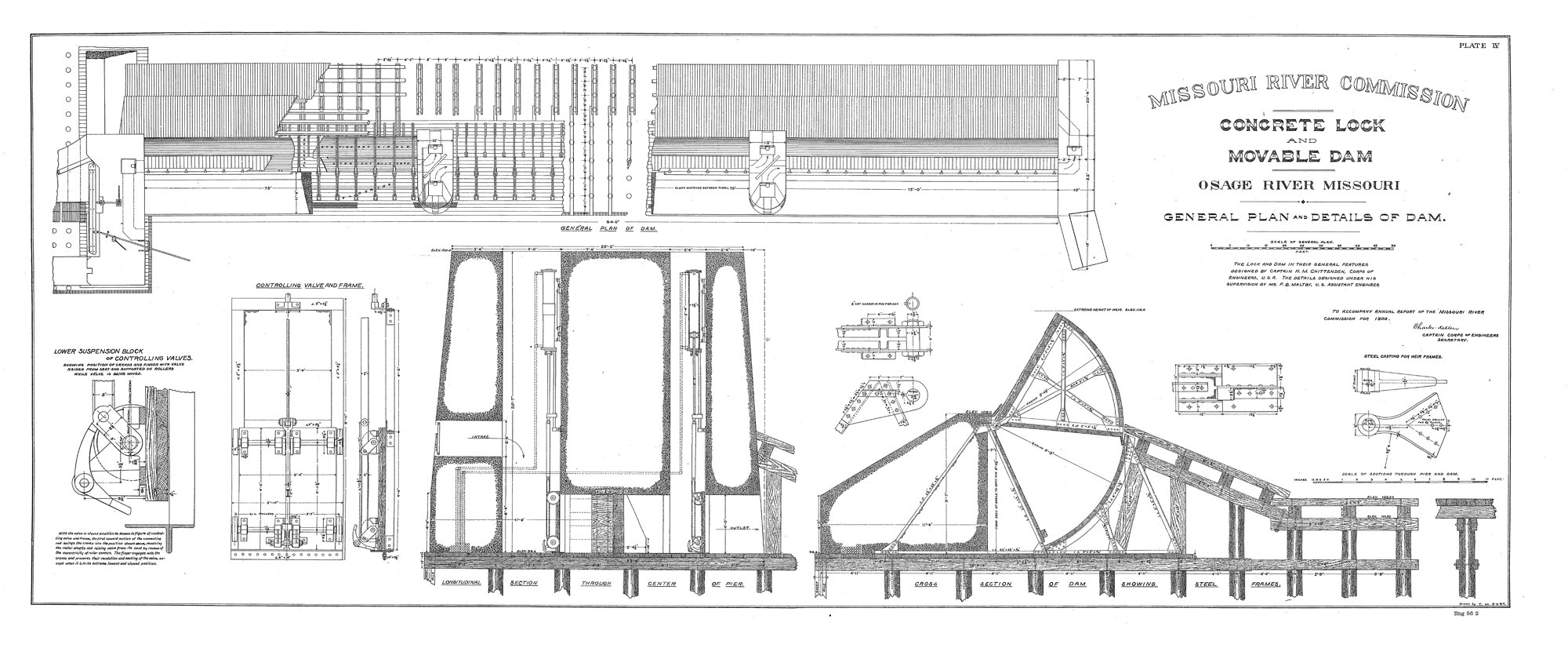
Schematic LnDNo.1

Local plans for improvements to the Osage River to make it a commercially navigable stream projected a series of locks and dams.  Work by the Corps of Engineers on the first one began in September 1895 at Shipley Shoals, then seven miles from the mouth of the Osage. A key feature of the project was the “Chittenden Drum Wicket”  (or the Chanoine wicket), the half-round section shown in this diagram. Designed by Army Corps Captain Hiram Martin Chittenden to regulate the flow of the river, the retractable 375-foot long iron mechanism was installed on top of a 9-foot concrete dam.  It was prone to being jammed by mud and clogged by drift and was eventually scrapped.

Soon after its completion in 1906 a 30-foot section of the dam collapsed.  That was rebuilt and for more than a century the lone lock and dam has served more as an impediment to river travel than as an improvement.

Capt. Chittenden redeemed himself with the Chittenden locks in Seattle, a complex of locks at the west end of Salmon Bay, part of Seattle‘s Lake Washington Ship Canal.  Chittenden became the Seattle District Engineer for the Corps soon after completion of Lock and Dam No. 1. Seattle’s locks include working fish ladders for salmon. They were formally opened in 1917 and are still in operation. Chittenden retired as a general.

Possibly he erred in his calculations for Lock and Dam No.1 because he was absorbed in the writing of multi-volume books on the fur trade in the West and on steamboating on the Missouri River. Remarkably, unlike other histories written in that era, these are still in print, and even available in e-book format. His guidebook to Yellowstone is also still in print.

Today there is growing interest in getting rid of Lock & Dam No.1. The sad, crumbling state of the structure was painfully exposed during the drought of 2012.  We have added a section to the Web site pulling together information on the current controversy surrounding Lock and Dam No. 1

http://www.dammingtheosage.com/lock-and-dam-no-1-on-the-osage-river/