Wednesday, August 20, 2014

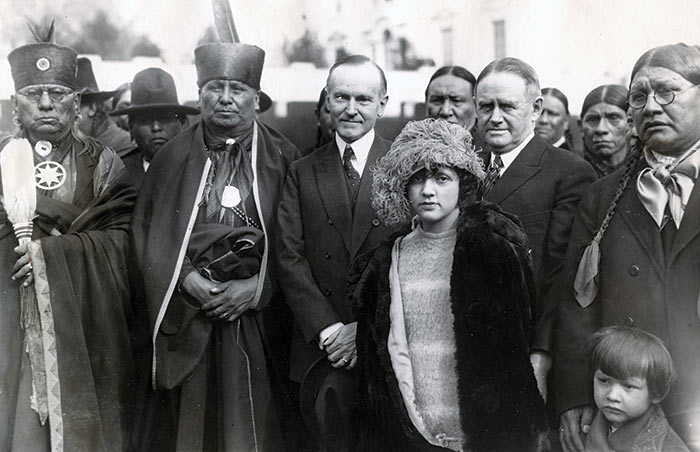
DELEGATION OF OSAGE INDIANS MEET WITH PRESIDENT CALVIN COOLIDGE - 1924

Osage Delegation meets with Pres. Calvin Coolidge


Press Photo, 8 x 10, dated January 23, 1924 (by UNITED)


Official caption pasted on the back of photo:


RICHEST INDIANS GREET PRESIDENT.
The delegation of Osage Indians, in the Capital seeking additional allowances from their government held incomes from oil lands, call at the White House and pose with President Coolidge.


Unfortunately the caption does not identify any of the Osages in the photograph. We wonder if the man on the far left is not Chief Bacon Rind (see previous posts: http://www.dammingtheosage.com/osage-chief-bacon-rind/#comment-196 ). We welcome confirmation of that guess or any identification of others in the photo.


Money generated by the sales of drilling rights had made enrolled Osages “probably the wealthiest people on earth” (New York Times November 18, 1898). Since 1897, oil wells have been drilled in Osage County, Oklahoma. With extraordinary foresight, the tribe had reserved subsurface mineral rights even though the land had been allocated among the 2,229 enrolled Osages. . . . . By the 1920s, those Osages who owned headrights, or shares based on their or their ancestors’ listing on the official rolls of 1906 had become rich from oil revenues.” (page 280, Damming The Osage)


Note the peace medals the two Osage men wear. Genuine medals today are quite valuable, but there are a lot of copies. The otter skin ‘bandeaus’ they wear are characteristic Osage head wear.


DELEGATION OF OSAGE INDIANS MEET WITH PRESIDENT CALVIN COOLIDGE - 1924

Tuesday, August 5, 2014

TWO LAKES - The Artificially Shallow and the Naturally Deep

July 20, 2014: The last Sunday in Colorado, we made a round trip drive along Trail Ridge Road from Estes Park to Grand Lake.

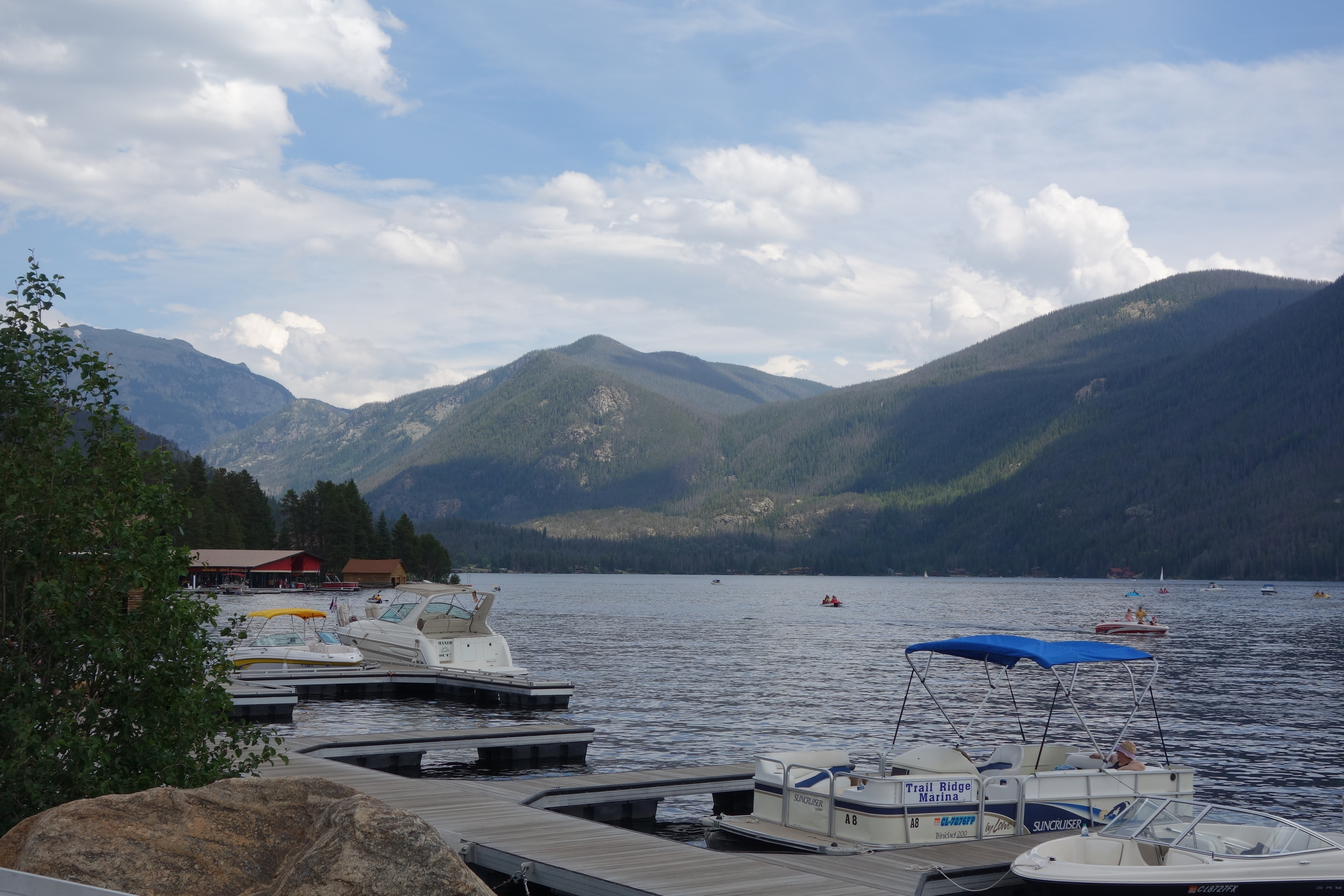
Grand Lake - elevation 8,367 feet; formed by glaciation 30,000 years ago; estimated depth, 265 feet.
Largest natural lake in Colorado and headwaters of the Colorado River
Grand Lake, Colorado: Largest natural lake in Colorado and headwaters of the Colorado River

July 27, 2014: Back home in Missouri, we made a Sunday drive to the Warsaw area and Truman Dam and Reservoir.

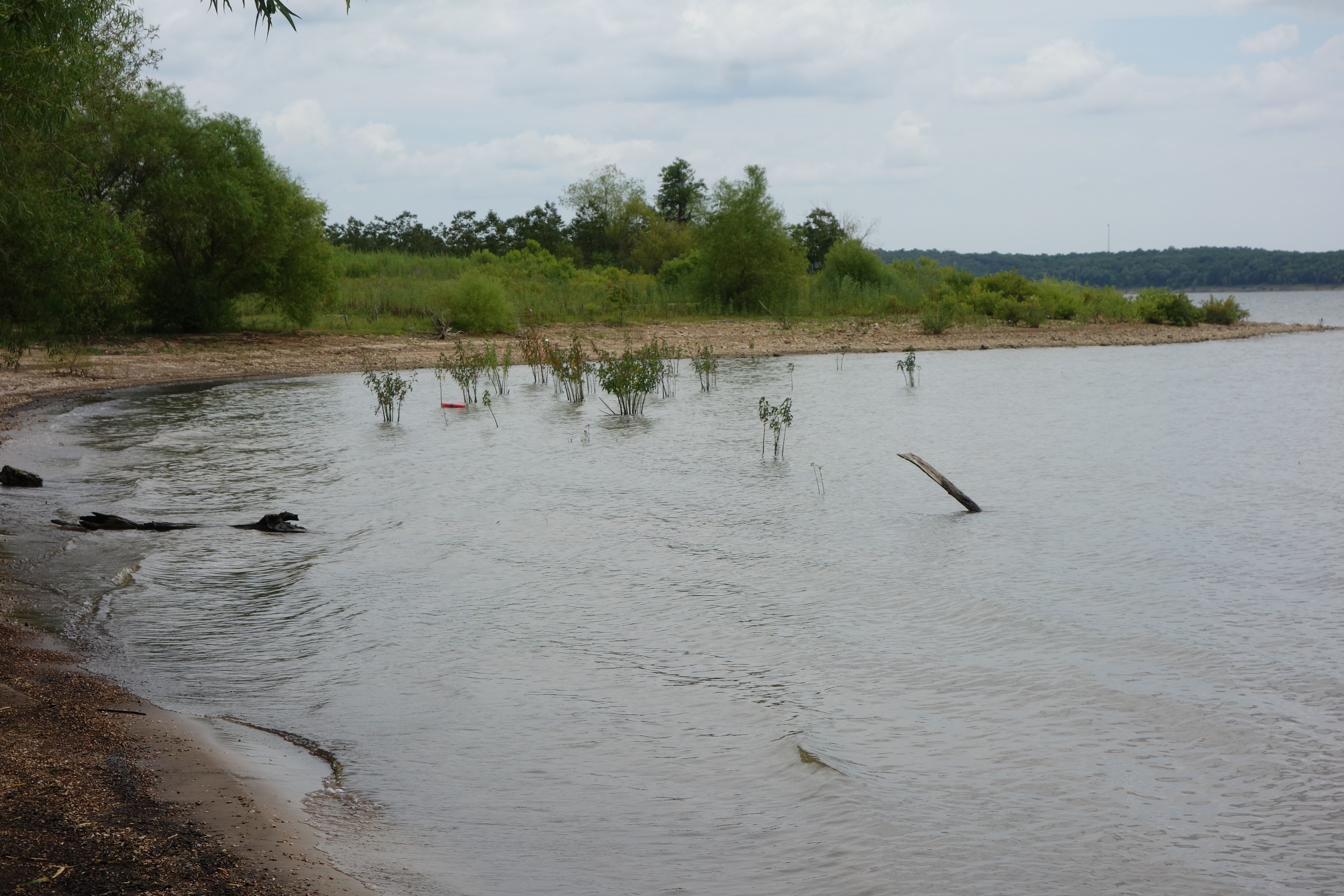
Truman Reservoir - elevation 706 feet; formed by the Corps of Engineers in 1979; average depth 22 feet.
Truman Reservoir on the Osage River: purpose - flood control, hydropower, recreation
Mountain lakes are commemorated in paintings, promoted on postcards and praised in poems. One could draw the conclusion that in areas of high relief, lakes are more successful. Even artificial lakes built for both flood control and hydropower purposes are more effective in mountainous areas. Blocking prairie streams with relatively gentle relief - like the Osage and South Grand rivers - creates inefficient flood storage and minimal hydropower possibilities. One would think the Corps of Engineers would have realized this. Actually - they probably did, but they were being incentivized by construction companies and encouraged by delusional local advocates and politicians. Today they would never undertake a marginal project like Truman Dam and Reservoir. Lessons have been learned ... at least we like to think so!

Sunday, June 1, 2014

Osage River Network tweeted our video on Lock and Dam No. 1


Saturday, May 24, 2014

WORLD TURTLE DAY - May 23, 2014

Sea turtles, soft shells, red eared sliders, basic box turtles - rare and endangered or common - they are the oldest species of reptile (see Wikipedia on turtles) ... and now they've got their own day!  Granted World Turtle Day was May 23 (yesterday) but that's no reason not to continue the celebration. And it's spring and turtles are on the move ... often in dangerous territory as they try to cross roads, even busy highways, to get to the other side. Drivers, please be aware!

Releasing Appollinaris, our Irish Wilderness turtle, to a safe environment

That is how we found a baby turtle crossing a road when we were in Ripley County researching Mystery of the Irish Wilderness ... In fact we were looking for Tucker Spring where John Joseph Hogan and a surveyor had forded the Current River on his first exploratory trip to the Ozarks in 1857.  His memoir describes a mill at that ford owned by Appollinaris Tucker. Sadly, Mrs. Tucker was on her deathbed:

At this place there was a mill and homestead owned and occupied by a man named Appollinaris Tucker; he and his family were the only Catholics known to be residing at that time in that district. At the time of my arrival, Mrs. Tucker was in the last stages of her mortal illness, in which it seemed God's Holy Will that she should linger until her longings could be gratified to receive the last Sacraments; and, as it happened, from the hands of the first priest known to have come into that region of country. After Mrs. Tucker’s death, I returned homewards, by way of Iron Mountain, St. Louis, and Hannibal, to Chillicothe.
(Mystery of the Irish Wilderness, page 25)

Appollinaris and Ellen Tucker purchased government land in 1854 and 1856 in Ripley County, Missouri. Presumably, Ellen was Mrs. Tucker, to whom Father Hogan administered the Last Rites . . . There is no record of the mill after the Civil War or of what became of Appollinaris. Tucker Bay Spring, a large (24 million gallons a day) but curiously unstudied spring, still flows into the Current River. 

Named in honor of the former mill owner, we let  our Appollinaris grow until large enough to take care of himself and then sent him on his way.

Thursday, May 8, 2014

Review of THE SCARS OF PROJECT 459: The Environmental Story of Lake of the Ozarks

Pollution at Lake of the Ozarks, complicated by denial and cover-ups


Naturally environmentalists are more concerned about the degradation of rivers, especially if they cut through uninhabited, scenic country, than a reservoir whose shores are lined with condos and whose waters are whipped to a froth by cabin cruisers. THE SCARS OF PROJECT 459, journalist Traci Angel’s lively account of water quality problems at Lake of the Ozarks, reports that when concerned citizen Barbara Fredholm contacted the Sierra Club to start a local chapter she was told, “the Lake of the Ozarks is a lost cause.”


459-bookThe Lake’s 55,000 acres of murky Osage River water is held back by Bagnell Dam, which was closed in 1931.  Ostensibly, Project 459 was to supply hydropower to lead mines in eastern Missouri, which were in a downward spiral of operation like all American industries at the beginning of the Depression.  The financing and justifications of Lake of the Ozarks were scandalous.  Two out of three of the drivers of the scheme ended up doing time in federal penitentiaries. The Lake’s origin smells like Polanski’s Chinatown, but without the murders and incest


Today, certain coves at Lake of the Ozarks stink from time to time, polluted by inadequately treated human and animal waste. The politics of dealing with the problem are complex, but driven more from old-fashioned self-interest than out and out corruption.  Still, this book reveals a pattern of inadequate response to a real problem.


It is understandable that the Sierra Club would have a minimal interest in an aging impoundment owned by a power company that is overbuilt and under-regulated, but the book finds the behavior of some politicians and government agencies unforgivable. In 2009 the Missouri Department of Natural Resources delayed releasing until after Memorial Day a report that had found dangerous levels of E. coli bacteria in popular swimming coves, fearing the tourist season would be harmed. The press ran with this story and it became a scandal. Heads rolled in Jefferson City.


Unfortunately, the lesson learned, Angel found, was that now our political and regulatory agencies run and hide when queried about water quality problems.  When she sought an interview with the Missouri Department of Natural Resources, she was told in an email: “We understand that the University of Arkansas Press has contracted with you to write this book, which will be sold for a profit. Given that we are a public agency supported by tax dollars, we have determined that it is not an appropriate use of limited staff time to participate in these types of interviews.”  The implication of such a policy pretty much shuts down the publication of books, newspapers, radio, television and magazines, as they are all “sold for a profit.”  Further, such a policy would shield from public scrutiny information derived from publicly funded research


When she tried to get information from Governor Jay Nixon she was told to check in with the Department of Natural Resources and “insofar as making the Department available for interviews, I believe the Department of Natural Resources is in the best position to make the call on that and I won’t be compelling them otherwise.”


So who will tell the truth about the environmental problems of a geriatric reservoir?  Actually, the author found a scattering of local residents, business people and a few politicians and bureaucrats who do approach the problem straightforwardly.  Apparently Angel herself is part of the American tradition of muckraking journalists – and there’s some smelly muck to rake down there in Lake of the Ozarks.


Modified landscapes, like dammed rivers, are still environments that can be further neglected and abused. Traci Angel does, by the way, point out some outstanding natural features like the spectacular Ha-Ha-Tonka State Park which is intelligently managed by a division of the Missouri Department of Natural Resources which dropped the ball on the pollution issue.


Lake of the Ozarks isn’t a lost cause but its heritage of lies and hype continue to plague its management.


The book is available at www.amazon.com


Review of THE SCARS OF PROJECT 459: The Environmental Story of Lake of the Ozarks
Thursday, March 6, 2014

What did Bishop John Joseph Hogan look like? CORRECTING THE RECORD


It’s time to set the record straight. A drawing of a seated, slightly slumped and rather – shall we say – out of shape-looking cleric was once identified as John Hogan by a Kansas City newspaper in the first quarter of the 20th century. 

We contend that early typesetter/caption-writer got it WRONG.  BUT the image and its egregious mis-attribution has persisted for a century.  This slumped and tired image has shown up in books and in magazine articles about the Irish Wilderness, the Irish experience in Kansas City and histories of the “churching” of Missouri. It’s time to clear that up.

Every description we’ve read describes him as tall and trim, an athletic, vigorous and fit man even late in life.  His official portraits show him sitting erect, trim and formally posed.


Photogravure portrait of Hogan from the 1889 "Illustrated History of The Catholic Church in the United States." Bishop Hogan remained a tall, slender, erect figure throughout his life. There is no mention of horseback riding in his later years (as he did during his missionary years), but his frequent five and six mile walks were duly noted by reporters.


Bishop Hogan was a favorite of reporters looking for comment on the news of the day, or just a feature story in a slow news cycle. In a 1906 profile of Hogan, The Kansas City Star noted:
In spite of his age, his tall form is erect and his eye flashes as it did fifty years ago. … Every afternoon he walks from four to six miles. He rides to the end of the car line or to some point upon it and walks back. … The bishop’s tall figure is a familiar one upon the streets. He wears always upon his walks a low-crowned, broad brimmed black felt hat, a long black coat… He walks slowly, deliberately, generally with his hands clasped in front and a meditative look upon his face.
(emphasis - underlining - added by me)


Silver anniversary cabinet card of Bishop Hogan, 1893.  (Mystery of the Irish Wilderness, page 123)


 When Hogan returned to Kansas City from his yearlong sabbatical in Ireland in 1895 a newspaper reporter described him at his arrival at Union Station:
Finally a man well advanced in years but with erect figure and eyes that flashed with pleasure as he saw the assembled host, stepped from the train.
Kansas City Journal,  Feb. 21, 1913, included this in the much longer account of the bishop on the occasion of his death:
Never was there a man more willing to give audience to the griefs of others than was Bishop Hogan. A moment after a visitor had been ushered into the big parlor of the episcopal home, with its old fashioned furniture, the large oil painting of the bishop on one wall of the room, the old books in the bookcases—the bishop would appear in the doorway and with that earnest look on his face that was so characteristic he would inquire:
          Well, my good friend?
Then he would listen to the story there was to tell or give his advice upon the many little troubles—or big ones—as the case might have been. In spite of his age, there was always that earnest expression, that tall, erect form and those eyes, flashing as they did fifty years ago.
. . .  the bishop never let business interfere with his regular afternoon walk. Then he would ride to the end of a car line and walk back—sometimes five or six miles.
With such reports and with the evidence of his official portraits, it seems most likely that the sketch so often identified as Hogan is not the Bishop himself.  So what would John Joseph Hogan himself think of this mix up? Given his self-effacing sense of humor, he would probably be amused!

Sunday, March 2, 2014

NEW IRELAND


Just ran across this scan of the 1875 Cram's Missouri map showing New Ireland's (purported) location.  Keeping in mind that J Highway today runs along the Ripley-Oregon county lines, you can see that this location is very near the present day site of Handy, MO.

NOTE: We have special reduced prices on all our books right now.  Check it out at our website: http://www.dammingtheosage.com/buy-the-book/