Showing posts with label White River. Show all posts

Wednesday, April 26, 2017

Moving on up!


We’re moving our Lens & Pen Press blog from Blogger to Word Press and will consolidate the two current blogs into one for our books--the Beautiful and Enduring Ozarks, the James Fork of the White (coming 2017), Damming the Osage, Mystery of the Irish Wilderness and See the Ozarks--and many other favorite topics of discussion like the Ozarks or water resources.

The archive of L&P posts is still available at http://lensandpen.blogspot.com/ 

The posts on our separate Damming the Osage website remain available at http://www.dammingtheosage.com/the-blog/

--------------------------------------------------------------------------------------------------------

COMING IN 2017: JAMES FORK OF THE WHITE: Transformation of an Ozark River.
Sample pages from this new book can be seen at www.beautifulozarks.com

Our earlier ‘river book,’ DAMMING THE OSAGE, can be seen at www.dammingtheosage.com


Saturday, March 25, 2017

TABLE ROCK - BLUFF AND DAM

 
April 2017
  
“Table Rock Dam will be built across the big sandbar.” 
Real photo postcard, 1920s, by Payne Johnson, Branson, Mo.

Shortly after Empire District Electric built Powersite Dam across the White River, creating Lake Taneycomo, the big electric company announced plans to build a 200-foot dam upriver at Table Rock Bluff.

Most bluffs along Ozark rivers are named. Table Rock Bluff had a relatively flat top and was accessible by road. A visit to this overlook was on many vacationers’ itinerary.  For decades locals anticipated seeing machinery in the valley below building a huge dam.  That this never occurred frustrated dam supporters and led them to question if the utility really intended to proceed. They didn’t.
The Army Corps would build Table Rock Dam many years later but the Corps didn’t build it at Table Rock. They moved the location two miles upstream to a more stable geological site, but kept the name.  Table Rock Bluff remains a popular scenic overlook, but is now fenced for safety – unlike the past as shown here.

COMING IN 2017: JAMES FORK OF THE WHITE: Transformation of an Ozark River.  
Sample pages from this new book can be seen at www.beautifulozarks.com 
Our earlier 'river book,' DAMMING THE OSAGE, can be seen at www.dammingtheosage.com


Tuesday, February 28, 2017

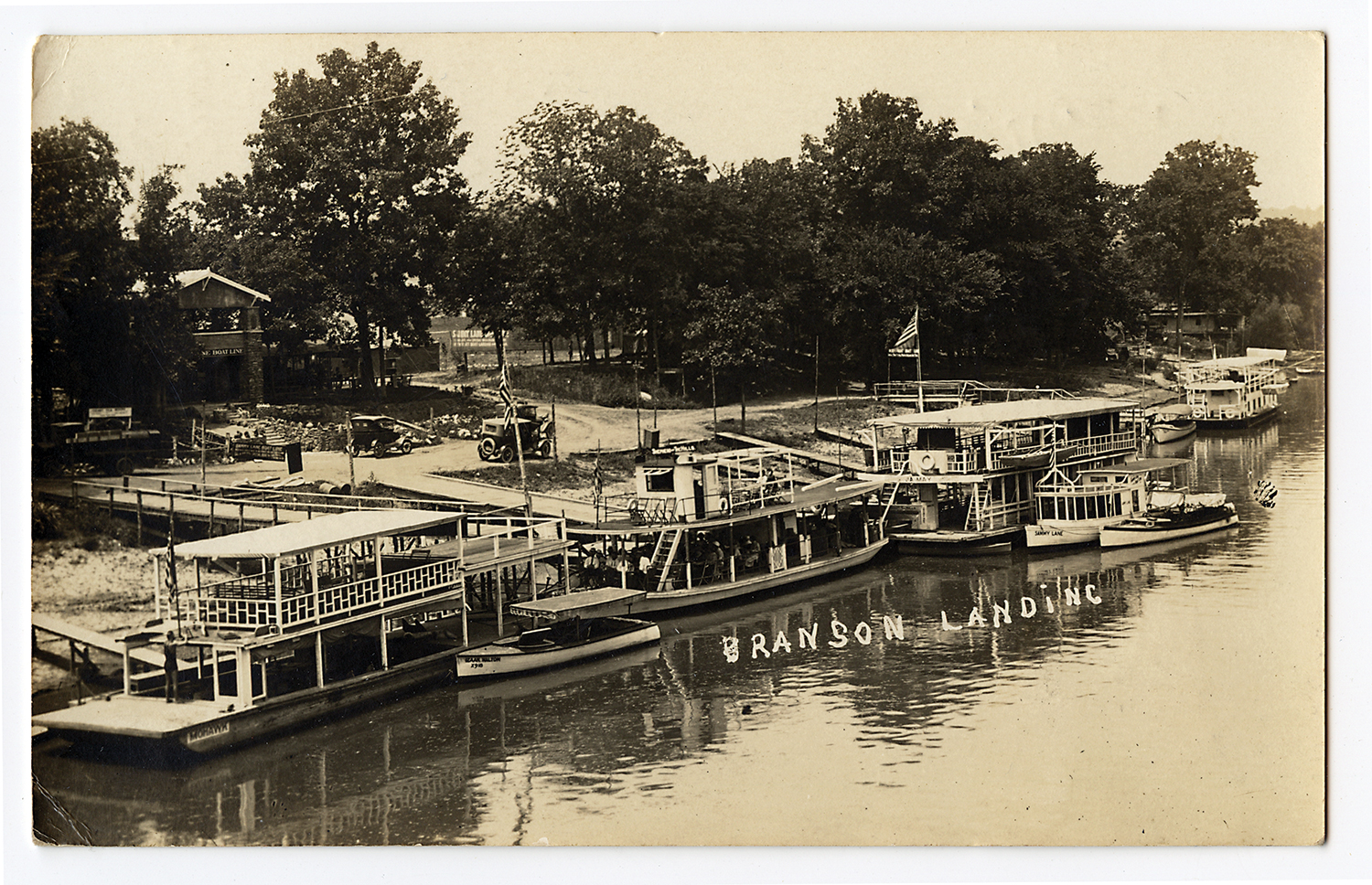
BRANSON LANDING - nearly 100 years ago! How things have changed!


Real photo postcard, c. 1925

Before the construction of the run-of-the-river hydroelectric Powersite Dam on the White River near Forsythe, float fishing was the primary sporting attraction for the Shepherd of the Hills Country. Lake Taneycomo, which filled in 1913, didn’t eliminate the celebrated Galena-to-Branson float, but it gave Branson and Hollister an advantage over Galena. The small lake was more compatible with larger, motorized watercraft than the shallow flowing James and White rivers in their native state.  By the mid-1920s the shoreline at Branson Landing was filled with larger motorized tour boats and smaller cruisers.  

The times - and Branson- are a-changin'! This shows just how different life a hundred years ago was in Branson. Motorized tour boats accommodated auto-delivered tourist who came to sightsee, not fish, float or commune with nature. Lake Taneycomo was compatible with Arcadianism but it opened the door to mass tourism. Today Branson Landing is a big modern shopping center, showing few traces of this earlier era.

COMING IN 2017: JAMES FORK OF THE WHITE: Transformation of an Ozark River.  
Sample pages from this new book can be seen at www.beautifulozarks.com 
Our earlier 'river book,' DAMMING THE OSAGE, can be seen at www.dammingtheosage.com

Tuesday, February 7, 2017

CHARLEY BARNES - JOHNBOAT BUILDER AND JAMES RIVER GUIDE


A lot has been written about the origin of the celebrated flat-bottomed wooden boats used on the James and White rivers. Outdoor writer Robert Page Lincoln wrote a long article on these boats, published in the March, 1948 issue of Fur-Fish-Game magazine, for which he extensively interviewed Galena river guide and boat builder Charley Barnes.

Robert Page Lincoln was a prominent writer on hunting and fishing in the 1930s through the 1950s. Seen here dressed like a running buddy of Ernest Hemingway, Lincoln observes Charley Barnes crafting a float boat. Lincoln wrote Barnes didn’t care for the name ‘johnboat.’


Charley Barnes guided Galena-to-Branson floats for forty years and built more than three hundred of the craft used in these trips. In a 1956 interview with Springfield News-Leader reporter Don Payton, Barnes said although he had “taken commercial floats on the Current River” and heard the term johnboat applied there, “We have never used that name here.” Barnes got in to the James River float business during its earliest commercialization, but soon realized, “‘the boats available weren’t big enough to accommodate occupants for much longer than a day.’ Barnes quickly came to the realization that greater cargo space was needed for tents, food, equipment, and other gear. The result was that Barnes, still working in Branson, fabricated a boat ‘about 20 feet long and a yard wide with a snub nose and flat bottom.’” The classic “float boat” created by Barnes and other Galena builders was more stable than “jack boats” as earlier long, narrow, flat-bottomed wooden boats were called. Johnboats couldn’t be as easily poled upstream but return by railroad made going upriver by boat unnecessary.

“This photo of Charley Barnes and his two brothers, Herbert and John, was taken in 1909 about the time that the Barnes float trip business at Galena, Mo., was at the height of its success. The bass shown in this photo are the same average size as those taken now. Reading left to right are Herbert, John, and Charley Barnes.” Caption from Robert Page Lincoln’s 1948 article in Fur-Fish-Game magazine.


COMING IN 2017: JAMES FORK OF THE WHITE: Transformation of an Ozark River.  
Sample pages from this new book can be seen at www.beautifulozarks.com 
Our earlier 'river book,' DAMMING THE OSAGE, can be seen at www.dammingtheosage.com
The caption from Robert Page Lincoln’s 1948 article reads:

Wednesday, February 1, 2017

Quest to Develop an Ozark River Boat

-->

Printed postcard, 1907
The photo appears to depict a family departing for an overnight outing. Boats could be rented from lodges, and self-guided trips were common throughout the float trip era. Both paddles and poles are evident. We wish this group, dressed for Sunday school, all the best as they prepare to drift down the beautiful James in these odd overloaded, probably unstable, pointed-bow skiffs, or punts, or whatever they were called.

The genesis of the square-ended, flat-bottomed boats specifically adapted for commercial floating on the James and White rivers is poorly documented. Many theories have been advanced as to how they were developed, and how they came to be called johnboats.

COMING IN 2017: JAMES FORK OF THE WHITE: Transformation of an Ozark River.  
Sample pages from this new book can be seen at www.beautifulozarks.com 
Our earlier 'river book,' DAMMING THE OSAGE, can be seen at www.dammingtheosage.com