Showing posts with label Ozarks. Show all posts

Wednesday, April 26, 2017

Moving on up!


We’re moving our Lens & Pen Press blog from Blogger to Word Press and will consolidate the two current blogs into one for our books--the Beautiful and Enduring Ozarks, the James Fork of the White (coming 2017), Damming the Osage, Mystery of the Irish Wilderness and See the Ozarks--and many other favorite topics of discussion like the Ozarks or water resources.

The archive of L&P posts is still available at http://lensandpen.blogspot.com/ 

The posts on our separate Damming the Osage website remain available at http://www.dammingtheosage.com/the-blog/

--------------------------------------------------------------------------------------------------------

COMING IN 2017: JAMES FORK OF THE WHITE: Transformation of an Ozark River.
Sample pages from this new book can be seen at www.beautifulozarks.com

Our earlier ‘river book,’ DAMMING THE OSAGE, can be seen at www.dammingtheosage.com


Tuesday, May 19, 2015

FACES LIKE DEVILS: The Bald Knobber Vigilantes in the Ozarks


A remarkable, in-depth and readable story of post Civil War vigilante bands in the Ozarks.
 Matthew J. Hernando’s new book, Faces Like Devils, is an engrossing account of the Bald Knobbers, a southwest Missouri vigilante movement that emerged as a result of post Civil War lawlessness.
Hernando places the Ozarks’ own vigilante groups in the broader context of American history: “Although often treated as a matter of local interest, the bloody history of the Bald Knobber organization informs a broader narrative of vigilante justice that has been a part of American history and culture from the beginning. It is a tradition literally older than the country itself.”  The Bald Knobbers are ideological cousins to the “Regulator” movements of colonial era North and South Carolina, San Francisco’s Committees of Vigilance during the California Gold Rush, ‘”fence cutting wars” in the West, and of course the KKK among many others.
This is not news for people in southwest Missouri. These were murderous nightriders whose “improvised dispensing of justice” has been written about and portrayed in locally produced plays and movies both fictional and documentary. The phenomenon has been subject of feature writers’ columns since their beginnings in the nineteenth century.  They were the heavies in Harold Bell Wright’s 1907 huge bestseller, Shepherd of the Hills. The Mabes, a talented country music family, pulled the words into one to name their Branson hillbilly music show. These popular appropriations, Hernando notes, may explain the relative sparseness of Bald Knobber scholarship: “The popular image of the Bald Knobbers may also have tainted the group with the stigma of sensationalism and provincialism, causing some historians who might otherwise have written about the group to defer from doing so.”
Two full-length books - Lucille Morris’s Baldknobbers, Caxton Press, 1939 and Elmo Ingenthron’s Bald Knobbers, Pelican Publishing, 1988 – have been published. Numerous popular articles, pamphlets and investigative journalist’s exposé have added detail and color to this compelling story.  The bibliography of Faces like Devils provides an extraordinarily comprehensive account of materials produced on the vigilantes in the last hundred years.
Hernando has absorbed all these. He has also delved deeply into voluminous court records and newspaper articles from the time. He applied microscopic examination of the condition of post Civil War turmoil that brought about this war, which involved 700-900 people at one time.  Night riding, hangings, floggings and gunfights were standard operating procedures.
Certainly this tumult was not good for business. Missouri’s Governor pushed the court system to crack down on these vigilantes in the mid 1880s. Four were sentenced to hang.  One got away.  The other three were executed in a horrifically inept public hanging on grounds of the Christian County courthouse in Ozark. 
For those that know the story – and many in our part of the country do – this is an unprecedented compendium of personalities. Though one name is popularly applied, there were two distinct groups – the Bald Knobbers of Taney County and the Bald Knobbers of Christian and Douglas counties.  The distinctions, Hernando contends, are important: “The two groups … used the same name, operated simultaneously, and inhabited roughly the same compact geographical area. Yet they exhibited such stark differences in their goals, tactics, and membership that it is sometimes difficult to see how they were considered part of the same group.” This book expertly clarifies these distinctions.
Faces Like Devils tells a gripping story with blind tigers, prostitutes that followed the railroad lines, and Yankees and Confederates fighting old battles. Hernando has produced a fascinating book, an easy read with good balance between academic research and readable prose.
 (NOTE:  This review is also posted on amazon.com: http://www.amazon.com/review/R2ZSDCV4P9UMSJ.  Check there for more information and purchase details.)

Friday, February 6, 2015

JOHN HOGAN AND JAMES FOX, FRONTIER PRIESTS AND LIFELONG FRIENDS


John Hogan, priest and bishop, and Father James Fox remained lifelong friends.  Father Fox continued his support of Hogan’s Ozarks settlement, sending cash and donating property. Hogan kept close accounting of the costs of building the wilderness settlement in a small pocket notebook, which rests now in the archives of the Archdiocese of St. Louis.  
 Hogan noted contributions for the construction of a log church in his Ozarks settlement.  Father Fox was most generous ($17.00)- especially when you consider that the actual cash cost for the log church in the wilderness came to $85.31 for material and labor.
 In addition to his cash contribution, Fox donated land for the church site. 
“Fox was issued a land patent on September 1, 1859 for 320 acres in Oregon County. The Irish pastor of Old Mines and Potosi donated it for the colony’s use. On this site, a forty-foot square log chapel and priest’s quarters were built by Father Hogan. On May 17, 1879, the property was sold for back taxes. For a long time, the outline of the church’s stone foundation was a visitable feature in “the priest’s field.” Through the years, the rocks have been appropriated for other building uses or removed to facilitate plowing. It is today a fescue pasture."
 
Mystery of the Irish Wilderness is now $16.95 (regularly $18.95), postpaid.
 
On the Mission in Missouri and Fifty Years Ago: A Memoir ,which contains full text of both of Hogan's personal memoirs as well as additional biographical information, is now $18.95 (regularly $24.95), postpaid.


Tuesday, September 23, 2014

THIS OLD WORLD by Steve Wiegenstein - a Review

-->
Utopian communities – designed to live a philosophy, often using experimental models of governing, wealth sharing, and re-defining the relationship between the sexes – were not uncommon in the nineteenth century. History.com states that 80 such communities were founded in the 1840s alone.  Daybreak, Missouri, setting of This Old World, could have been one of them.

Steve Wiegenstein’s new historical novel propels the reader through the passions and tragedies of this fictional, but very convincingly real, experiment in the Ozarks wilderness. As the reader advances deeper into the lives and events of the citizens of the small Ozark town of Daybreak, each short chapter ends with an enticing lead-in to the next.  “Just a few more pages tonight…”

The “situation report” of this second novel in the Daybreak trilogy comes in Chapter Two when James Turner, who has returned a changed man from his service to the Union, mulls over their rocky descent from idealistic, hopeful community that would lead the way to a new, better social order. Their once bright optimism now "seemed like a relic from an antique time." The ravages of the Civil War has left them struggling to survive the failings of human character as well as the brutalities and privations of warfare – military and guerrilla.

Wiegenstein has put faces and strong characters to the tantalizing questions of history: who were the people beneath the tombstones of a country graveyard?  Who were the individuals who filled the ranks behind the generals, preachers, politicians who shaped history’s larger events?  Who tilled the soil, built the buildings, ground the wheat of the utopian communities? How did they live their lives? What kept them going?

I was sorry to encounter one character who was an embittered survivor of a real Missouri pre-Civil War utopian experiment. Still, his bad behavior begs the question – was he always that way or did the brutal Civil War, the loss of wife, family and settlement make him so?  His pre-Civil War home, Father John Joseph Hogan’s Irish Settlement in Oregon and Ripley counties (now included in the National Wilderness system as the Irish Wilderness) was not fiction. It was a real community for a few years before the Civil War, but failed because of exterior forces – the Civil War.

I read This Old World without having read the first volume of the trilogy, Slant of Light. However, Wiegenstein’s subtle references to the earlier time and past relationships are woven skillfully into this new volume so new readers are not left in the dark, but are enticed to go back to flesh out the original inspiration for Daybreak and make acquaintance with its young and hopeful leaders in the first volume.

This Old World is available on amazon.com


Wednesday, September 4, 2013

John Jospeh Hogan and the cost to build a log church in the Irish Wilderness

One of the revealing documents we found in our search for information on the Irish Wilderness was a small, pocket-size account book belonging to John Hogan. He kept records in this little notebook of expenses incurred and work accomplished in 1858 and 1859, the years of the building of the settlement in the Ozarks. The telling details of daily transactions - hiring a settler to cut timber, buying supplies at the store (coffee, tea and ague medicine), the cost of a yoke of oxen ($40) - these bring life and breath to the image of life on that pre-Civil War Ozarks frontier. (pages 48 and 49 in Mystery of the Irish Wilderness)

-->
Paid for Church
100 feet plank                        $17.00
2000 boards at 62 per hun       12.40
1000 D_lost by five                   6.20
hauling lumber 4 day at 2          8.00
hauling Shingles 1 day              2.00
D logs for floor 1                       2.00
D logs for buildings 3                6.00
4 days notching 126 1/2             5.06
1/2 day hewing                             .65
Man roofing 4 days                    4.00
400 feet plank                             4.00
hauling same                               2.00
Building fireplace                       3.50
Nails & hardware                        5.00
Calicos Candlestick & _______ 5.50
Altar linens                                 2.00
                                                $85.31
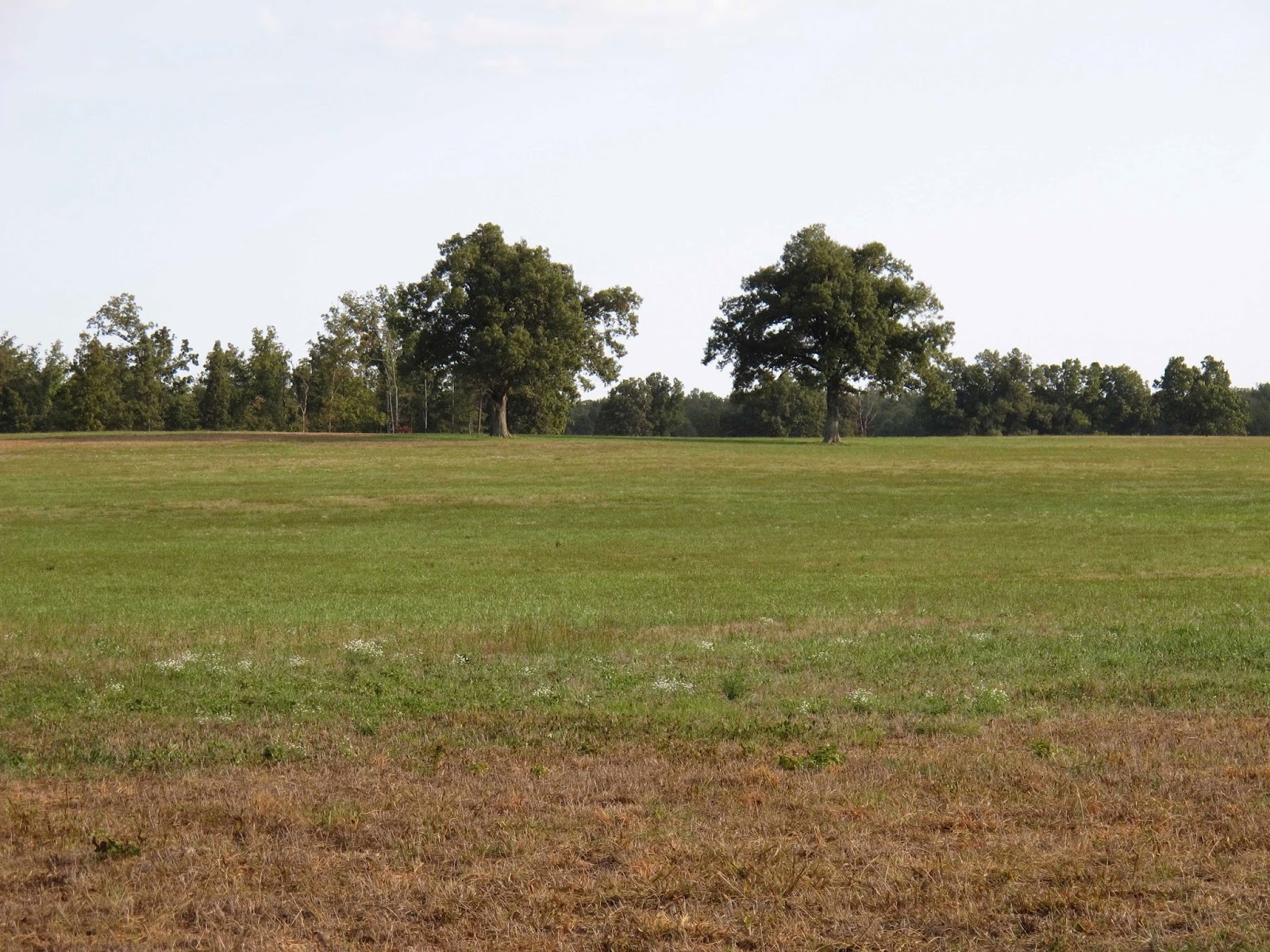
We think the little log church was built in area near these two trees in Oregon County.

So - the cost of a log church in the pre-Civil War Ozarks was $85.31.  But how to pay for it? Another page details accounts "Rec'd for the Church" which add up to $75.45, leaving a deficit of just $9.86 - a sum many clergy might envy when it comes to church building.

Hogan built more churches during his career:  the little church at Chillicothe, whose stained glass windows were shattered by anti-Catholic night riders - "gentlemen of grips and signs" - who "belabored with sticks and guns the artistic little gems..."; a cathedral for St. Joseph, Missouri, more lavish than he wanted by urging of his most influential parishioner; and the Cathedral of the Immaculate Conception in Kansas City (first services in 1883) with its now-gold-plated dome. 

In On the Mission in Missouri, Hogan mentions other churches he helped build across north Missouri, but often he doesn't mention their names. One small church built in 1865, however, he does describe:  St. Bridget's church at Peabody (later called Lingo), Missouri, "a small neat, convenient frame church was built, at a cost of about eight hundred dollars, which was subscribed and paid without delay. ... I loved the little building for its name, its devotional seclusion, and the piety of the people who attended it.