Showing posts with label irish wilderness. Show all posts

Thursday, March 16, 2017

"The Forgotten Irish" Event at the National Archives Tonight

Tonight, the National Archives is hosting the release of The Forgotten Irish: Irish Immigrant Experiences in America, by Damien Shiels.  Mr. Shiels has impressive credentials as an archaeologist and military history writer.


The title is intriguing. According to the editorial write ups, the 35 families whose stories are told within its pages were (East Coast) families of soldiers who died in the Civil War. I would expand the "forgotten" category to include the pre-Civil War settlers in Missouri's Irish Wilderness!

The event will be live streamed on youtube.  I for one will be watching.


St Patricks Day

In honor of St. Patrick and my Irish ancestors, Lens & Pen Press is offering Mystery of the Irish Wilderness ($18.95 retail) for $15, postage paid, during the month of March!  Order your copy at: http://www.dammingtheosage.com/buy-the-book/
_______________________________________________________________________

COMING IN 2017: JAMES FORK OF THE WHITE: Transformation of an Ozark River.  
Sample pages from this new book can be seen at www.beautifulozarks.com 
Our earlier 'river book,' DAMMING THE OSAGE, can be seen at www.dammingtheosage.com

Tuesday, March 14, 2017

Is Handy, Missouri, our own "New Ireland"?


Located just east of J highway in Ripley County, a few miles north of the Irish Wilderness, lies the tiny hamlet of Handy, Missouri. In 1859 and 1860 when Irish settlers were arriving, this area had a heavy concentration of land patents with Irish names as claimants. The ravages of the Civil War in this remote Ozarks land disrupted, some say destroyed, Father Hogan's once-hopeful colony. After the war, one could draw the conclusion that some settlers may have returned – a possibility suggested by tombstones in the Catholic Cemetery near Ponder as well as by a Cram’s 1875 map showing the tantalizing name, New Ireland, in the approximate location of Handy. (see page 76 of Mystery of the Irish WIlderness). 


Written on the back of this unmailed postcard is the following information:
Noah Haney Founder of Handy Post office was commissioned as Post-Master Sep. 9, 1913 – Resigned in favor of his daughter Mrs. Catherine Probst Oct, 28 1932 – Mrs. Probst served as Acting P.M. until Commissioned as Postmaster May 13 1935 – and continued as same until Post Office was closed Nov. 30 – 54 – Mail was carried from Fremont, MO by truck – in Carter Co.
In her master’s thesis, "Place Names Of Five Southern Border Counties Of Missouri,"  (University of Missouri, 1945) Cora Ann Pottenger recounts the story of how the Handy Post Office got its name:
Established in Noah Haney's small country store. The story is told that because of poor penmanship in the petition, the postal authorities mistook the suggested name Haney for Handy. Some remarked that the name was appropriate for it would now be so "handy"--convenient--to get the mail twice a week right at home, instead of going the long distance to Pine. (A.C. Randel; J. Whitwell; Harry Thaxton; Postal Guide 1915-)


Deer hunters – Real Photo Postcard probably 1940s or early ‘50s. Written on back,  "POV Handy Mo. Smallest P.O. in Mo. 7 feet 6 inches by 9 feet 6 inches."


St Patricks Day

In honor of St. Patrick and my Irish ancestors, Lens & Pen Press is offering Mystery of the Irish Wilderness ($18.95 retail) for $15, postage paid, during the month of March!  Order your copy at: http://www.dammingtheosage.com/buy-the-book/
_______________________________________________________________________

COMING IN 2017: JAMES FORK OF THE WHITE: Transformation of an Ozark River.  
Sample pages from this new book can be seen at www.beautifulozarks.com 
Our earlier 'river book,' DAMMING THE OSAGE, can be seen at www.dammingtheosage.com

Sunday, March 12, 2017

NEW IRELAND (s) - the hope of many immigrants

Young Father John Joseph Hogan was not the only Irish idealist hoping to establish communities for those he described as "people of small means." His exploratory forays into the Ozarks did result, however briefly, in the establishment and growth of a small settlement mostly in Oregon and Ripley counties.

On a Cram's 1875 Missouri map is the enigmatic toponym, New Ireland. It appears to be located near the present day site of Handy, an area that had a heavy concentration of 1859 and 1860 land patents with Irish claimants. No historical society has any documentation or record of new Ireland as a Missouri place name. 

Lynn Morrow, noted Ozarks historian, provided this opinion: "Cram's 1875 map has a number of these idiosyncratic place names ... that, like New Ireland, occur for a short time and then disappear and are not repeated by subsequent cartographers, although I (and no one else) have not systematically compared them. I don't know if there is a source that explains where Cram got all of his information, but it's certainly not all from surveys and post office records."

Chapter 20 of Tim Egan's recent best seller, The Immortal Irishman, is entitled "New Ireland."  In it he notes the American consul in Dublin, William West, in the late days of the Civil War proposed rewarding Irish solders for the Union with 'some desirable portion of our territories and call it New Ireland, of which no doubt General Meagher would in due time be elected Governor."

Thomas F. Meagher ("The Immmortal Irishman" of the title) in his post-Civil War career sought to find that 'desirable portion of our territories' for the Irish in Montana Territory. Meagher was painfully aware of the abysmal tenement conditions in which East Coast Irish families mostly lived. Hogan's pre-Civil War concern was the plight of Missouri's Irish (servant girls and railroad workers could not - by the nature of their separate employment circumstances - meet, marry and raise good Irish Catholic families).

Google the phrase, New Ireland, and other locations show up. Some have an actual community associated with it.

!!HAPPY ST. PATRICK'S DAY!!

In honor of St. Patrick and my Irish ancestors, Lens & Pen Press is offering Mystery of the Irish Wilderness ($18.95 retail) for $15, postage paid, during the month of March!  Order your copy at: http://www.dammingtheosage.com/buy-the-book/
_______________________________________________________________________

COMING IN 2017: JAMES FORK OF THE WHITE: Transformation of an Ozark River.  
Sample pages from this new book can be seen at www.beautifulozarks.com 
Our earlier 'river book,' DAMMING THE OSAGE, can be seen at www.dammingtheosage.com

Saturday, May 2, 2015

MOUNT IRISH WILDERNESS, Nevada, and new WILDERNESS IN COUNTY MAYO

Some might ask if the "Irish Wilderness" is a geographic place - or an Irish state of mind? Our book Mystery of the Irish Wilderness explored the history of a real place in the Missouri Ozarks, once populated by real Irish immigrants seeking a new life, a place now a component of the National Wilderness system.

Come to find there are other Irish Wildernesses, like Mount Irish Wilderness in Nevada's Basin and Range: "a 28,274-acre parcel less than two hours’ drive north from Las Vegas, harbors the parched region’s most precious resource: water."

And in 2013, The Irish Department of Art, Heritage and Gaeltacht and Coillte signed a Memorandum of Understanding, creating the country's first wilderness area in the Nephin Beg Range of North West Mayo.  This is a project with a twist ... the plan is to "rewild" 4,400 hectares of land to provide "a dedicated wilderness of forest, mountain, bog, river and lakes in the Nephin Beg Range." Wild Nephin is a fascinating and ambitious project, it's "the first of its kind in Western Europe."


An Taoiseach Enda Kenny TD, photographed at Néifinn Fhiáin in North Co. Mayo with from Left to Right Mr. Jimmy Deenihan, Minister for Arts, Heritage and the Gaeltacht, Dennis Strong National Parks & wildlife Services, and Bill Murphy, Head of Recreation Coillte to mark the  signing of a Memorandum of Understanding (MoU) between Coillte and the Department of Arts, Heritage and the Gaeltacht that designates 11,000 HA along the Nephin Mountain Range as Ireland’s first wilderness area. March 14, 2013
(Images released by Ken Wright Photography)

Friday, February 6, 2015

JOHN HOGAN AND JAMES FOX, FRONTIER PRIESTS AND LIFELONG FRIENDS


John Hogan, priest and bishop, and Father James Fox remained lifelong friends.  Father Fox continued his support of Hogan’s Ozarks settlement, sending cash and donating property. Hogan kept close accounting of the costs of building the wilderness settlement in a small pocket notebook, which rests now in the archives of the Archdiocese of St. Louis.  
 Hogan noted contributions for the construction of a log church in his Ozarks settlement.  Father Fox was most generous ($17.00)- especially when you consider that the actual cash cost for the log church in the wilderness came to $85.31 for material and labor.
 In addition to his cash contribution, Fox donated land for the church site. 
“Fox was issued a land patent on September 1, 1859 for 320 acres in Oregon County. The Irish pastor of Old Mines and Potosi donated it for the colony’s use. On this site, a forty-foot square log chapel and priest’s quarters were built by Father Hogan. On May 17, 1879, the property was sold for back taxes. For a long time, the outline of the church’s stone foundation was a visitable feature in “the priest’s field.” Through the years, the rocks have been appropriated for other building uses or removed to facilitate plowing. It is today a fescue pasture."
 
Mystery of the Irish Wilderness is now $16.95 (regularly $18.95), postpaid.
 
On the Mission in Missouri and Fifty Years Ago: A Memoir ,which contains full text of both of Hogan's personal memoirs as well as additional biographical information, is now $18.95 (regularly $24.95), postpaid.


Saturday, November 15, 2014

November 15, 1857 - FATHER HOGAN'S SECOND EXPLORATORY TRIP TO THE OZARKS

-->
This time Hogan's companion on the trail was his mentor and dear friend, Father James Fox, pastor of St. Joachim's church in Old Mines. Hogan was apparently excited by the settlement opportunities he had seen on his first swing through the eastern Ozarks. According to parish records, he returned to Chillicothe October 15 and a month later (Nov. 15) he was headed south once again to ride deeper into the much more affordable real estate of the Ozarks.

Father Fox, a native of County Wicklow, Ireland, shared Hogan’s concern for the waves of arriving poor immigrants who could not afford to establish themselves in this new land, with land or homes or businesses. For three weeks they rode through southeast Missouri.  That they both came from rural backgrounds, with knowledge of agriculture and the kind of land needed to support a farming operation was an invaluable asset in their evaluation of the terrain.


MY DEAR FRIEND FATHER FOX
 Arrived at Chillicothe, I corresponded without delay, with my dear friend and worthy brother priest, Rev. James Fox, rector of St. Joachim's church, Old Mines, Missouri, who as I well knew, was deeply concerned for the matter of land ownership and occupancy by Catholic emigrants. The incidents of my late journey, which I related to him, so interested him that he requested to be permitted to accompany me on another such journey, if I should have occasion to make one. I wrote to him to be ready and that I would soon call on him.

        Before many days, and in the latter part of November, we set out together on horseback from Old Mines. Traveling by way of Caledonia and Edgehill, we passed through Centerville the county seat of Reynolds County. Thence entering Shannon County, we descended Blair Creek, remarkable for its alternate limestone and red porphyry hills. Afterwards, we crossed the Current River at the mouth of Jack's Fork,


The Jack's Fork River (on left) flows into the Current. Close to this spot, Hogan and Fox forded the Current in 1857 on their November trip to explore possible sites for a settlement in the Ozarks

thence to Eminence, thence to Birch Tree, thence to Thomasville, thence to Pike Creek, thence to Van Buren, thence to Ten Mile Creek, thence to Black River, thence by way of Otter Creek, McKenzie Creek and Big Creek, through Caledonia and Potosi, homeward. Reynolds County we found entirely unfit for settlement, not one tenth of the land being tillable. Shannon and Oregon counties had much tillable land, perhaps one-third of the whole area, but none of it of prime quality except the river alluvial bottoms. Everywhere through these two last named counties, there was good stock range and abundance of valuable pine forest.

Thomasville in Oregon County is situated in this broad alluvial valley along the Eleven Point River.  

Both Hogan and Fox brought to bear their complete grasp of agricultural and industrial technologies and supremely practical analysis of the opportunities and limitations available.  Hogan definitely intended this settlement to succeed.

SPECIAL PRICES: Mystery of the Irish Wilderness is now $16.95 (regularly $18.95), postpaid: and On the Mission in Missouri and Fifty Years Ago: A Memoir is $18.95 (regularly $24.95), postpaid.



Thursday, October 9, 2014

HOGAN’S FIRST EXPLORATORY TRIP TO THE MISSOURI OZARKS – September 24 to October 15, 1857

About this time of year, in the early autumn of 1857, John Joseph Hogan left Chillicothe to survey the cheaper, government land available for purchase in the Ozarks. Look at a road map today and you’ll realize that there still is not an easy way to cover those 400-plus miles from his chosen mission in Chillicothe to southeast Missouri.  Still he was determined:
 
It seemed to me to be my duty to do whatever might be in my power, to aid these people to rise from their condition of servitude, to ownership and cultivation of land, so as to secure for them, beyond doubt, a settled and permanent mode of existence, that would accord better with their higher social aspirations and religious principles. This, however, could not be done in North Missouri, where land was held at too high a price. 

Hogan wasn’t one to plunge off without a plan.  He had procured plots and surveys of available government lands in the Ozarks and knew where he was going. The itinerary he lists in his memoir (On the Mission in Missouri: 1857-1868) of his first trip southward is short, but it would have been an arduous journey by steamboat on the Missouri River to St. Louis, then train to Iron Mountain or Frederick Town, then by horseback into the hills and over rivers for several weeks. 

SURVEYING
Traveling by way of Brunswick, Jefferson City, St. Louis, Old Mines, Potosi, Iron Mountain and Frederick Town, I halted at Greenville, in Wayne County, where I hired a surveyor familiar with the country. I examined the lands on the head waters of Little Black River, Cane Creek, Brushy Creek, in Ripley (now Carter) county, and entered four hundred and eighty acres in a body on Ten Mile Creek, making arrangements at once to put men thereon, opening and cultivating it. 
With the surveyor I rode westward, across the Current River, by Van Buren, up Pike Creek, thence southward over the great divide east of Eleven Points River as far as the head waters of Buffalo Creek, thence eastward along Buffalo Creek and its tributaries to a ford on Current River. At this place there was a mill and homestead owned and occupied by a man named Appollinaris Tucker; he and his family were the only Catholics known to be residing at that time in that district. At the time of my arrival, Mrs. Tucker was in the last stages of her mortal illness, in which it seemed God's Holy Will that she should linger until her longings could be gratified to receive the last Sacraments; and, as it happened, from the hands, of the first priest known to have come into that region of country. After Mrs. Tucker’s death, I returned homewards, by way of Iron Mountain, St. Louis, and Hannibal, to Chillicothe.
Appollinaris and Ellen Tucker purchased government land in 1854 and 1856 in Ripley County. There is no record of the mill after the Civil War or of what became of Appollinaris Tucker.


Tucker Bay Spring, with 24 million gallons a day, is #18 on the list of Missouri's 20 largest springs. A Google search brings up little information and few pictures.  It's located on Forest Service land in the Mark Twain National Forest in Ripley County and the site is difficult to get to. The spring does not have a dramatic gushing-forth-from-the-rocks beauty like Greer Springs or Big Springs, but rises along the lower one-third mile of an intermittent stream, at the base of a hill, seeming to come from a fault. Other than this account by John Joseph Hogan, there seems to be very little known about it or the people who might have lived by it. Tucker Bay Spring remains one of the mysteries in the region known as the Irish Wilderness.

SPECIAL PRICES: Mystery of the Irish Wilderness is now $16.95 (regularly $18.95), postpaid: and On the Mission in Missouri and Fifty Years Ago: A Memoir is $18.95 (regularly $24.95), postpaid.


Tuesday, September 23, 2014

THIS OLD WORLD by Steve Wiegenstein - a Review

-->
Utopian communities – designed to live a philosophy, often using experimental models of governing, wealth sharing, and re-defining the relationship between the sexes – were not uncommon in the nineteenth century. History.com states that 80 such communities were founded in the 1840s alone.  Daybreak, Missouri, setting of This Old World, could have been one of them.

Steve Wiegenstein’s new historical novel propels the reader through the passions and tragedies of this fictional, but very convincingly real, experiment in the Ozarks wilderness. As the reader advances deeper into the lives and events of the citizens of the small Ozark town of Daybreak, each short chapter ends with an enticing lead-in to the next.  “Just a few more pages tonight…”

The “situation report” of this second novel in the Daybreak trilogy comes in Chapter Two when James Turner, who has returned a changed man from his service to the Union, mulls over their rocky descent from idealistic, hopeful community that would lead the way to a new, better social order. Their once bright optimism now "seemed like a relic from an antique time." The ravages of the Civil War has left them struggling to survive the failings of human character as well as the brutalities and privations of warfare – military and guerrilla.

Wiegenstein has put faces and strong characters to the tantalizing questions of history: who were the people beneath the tombstones of a country graveyard?  Who were the individuals who filled the ranks behind the generals, preachers, politicians who shaped history’s larger events?  Who tilled the soil, built the buildings, ground the wheat of the utopian communities? How did they live their lives? What kept them going?

I was sorry to encounter one character who was an embittered survivor of a real Missouri pre-Civil War utopian experiment. Still, his bad behavior begs the question – was he always that way or did the brutal Civil War, the loss of wife, family and settlement make him so?  His pre-Civil War home, Father John Joseph Hogan’s Irish Settlement in Oregon and Ripley counties (now included in the National Wilderness system as the Irish Wilderness) was not fiction. It was a real community for a few years before the Civil War, but failed because of exterior forces – the Civil War.

I read This Old World without having read the first volume of the trilogy, Slant of Light. However, Wiegenstein’s subtle references to the earlier time and past relationships are woven skillfully into this new volume so new readers are not left in the dark, but are enticed to go back to flesh out the original inspiration for Daybreak and make acquaintance with its young and hopeful leaders in the first volume.

This Old World is available on amazon.com


Wednesday, September 4, 2013

John Jospeh Hogan and the cost to build a log church in the Irish Wilderness

One of the revealing documents we found in our search for information on the Irish Wilderness was a small, pocket-size account book belonging to John Hogan. He kept records in this little notebook of expenses incurred and work accomplished in 1858 and 1859, the years of the building of the settlement in the Ozarks. The telling details of daily transactions - hiring a settler to cut timber, buying supplies at the store (coffee, tea and ague medicine), the cost of a yoke of oxen ($40) - these bring life and breath to the image of life on that pre-Civil War Ozarks frontier. (pages 48 and 49 in Mystery of the Irish Wilderness)

-->
Paid for Church
100 feet plank                        $17.00
2000 boards at 62 per hun       12.40
1000 D_lost by five                   6.20
hauling lumber 4 day at 2          8.00
hauling Shingles 1 day              2.00
D logs for floor 1                       2.00
D logs for buildings 3                6.00
4 days notching 126 1/2             5.06
1/2 day hewing                             .65
Man roofing 4 days                    4.00
400 feet plank                             4.00
hauling same                               2.00
Building fireplace                       3.50
Nails & hardware                        5.00
Calicos Candlestick & _______ 5.50
Altar linens                                 2.00
                                                $85.31
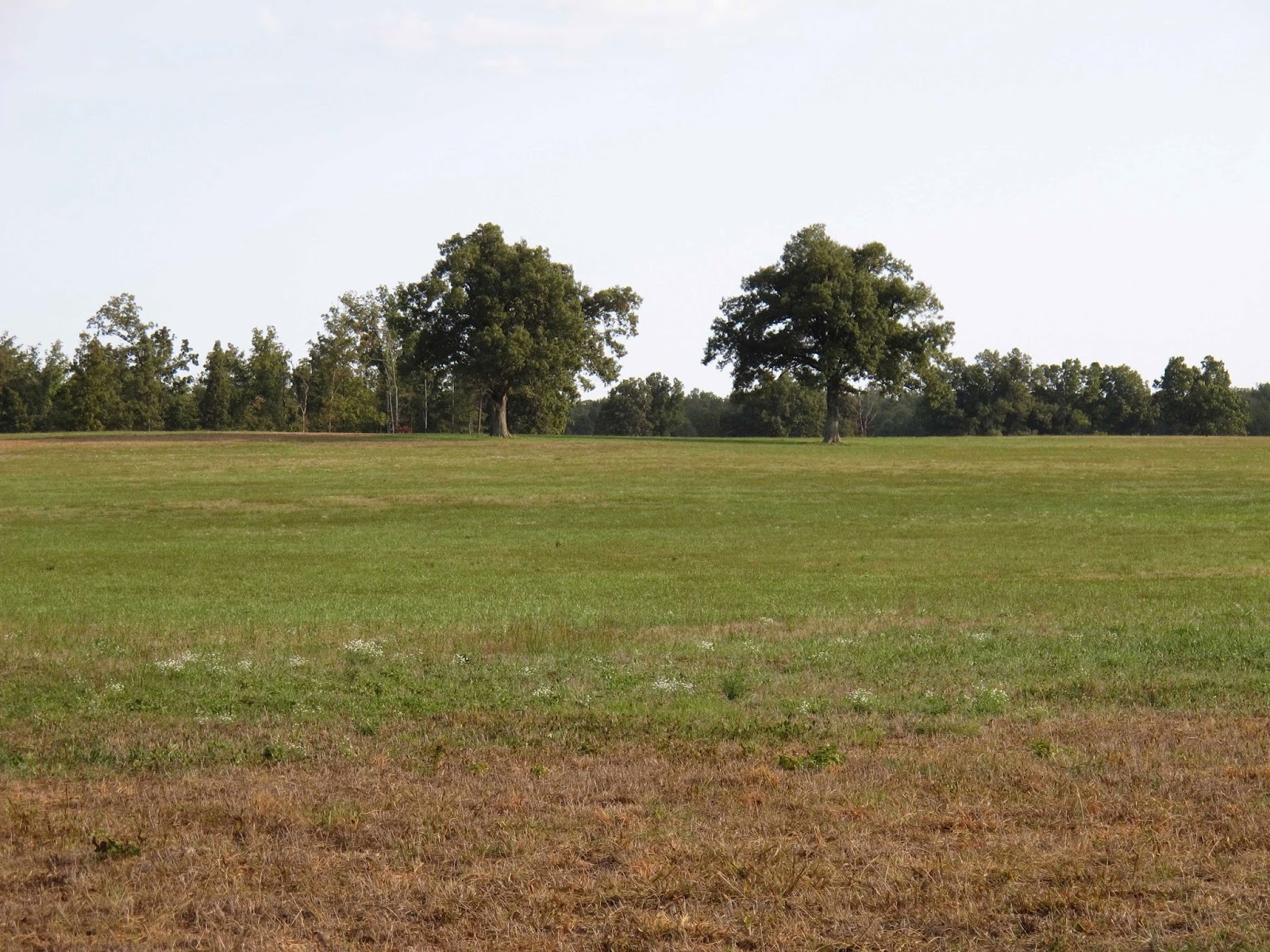
We think the little log church was built in area near these two trees in Oregon County.

So - the cost of a log church in the pre-Civil War Ozarks was $85.31.  But how to pay for it? Another page details accounts "Rec'd for the Church" which add up to $75.45, leaving a deficit of just $9.86 - a sum many clergy might envy when it comes to church building.

Hogan built more churches during his career:  the little church at Chillicothe, whose stained glass windows were shattered by anti-Catholic night riders - "gentlemen of grips and signs" - who "belabored with sticks and guns the artistic little gems..."; a cathedral for St. Joseph, Missouri, more lavish than he wanted by urging of his most influential parishioner; and the Cathedral of the Immaculate Conception in Kansas City (first services in 1883) with its now-gold-plated dome. 

In On the Mission in Missouri, Hogan mentions other churches he helped build across north Missouri, but often he doesn't mention their names. One small church built in 1865, however, he does describe:  St. Bridget's church at Peabody (later called Lingo), Missouri, "a small neat, convenient frame church was built, at a cost of about eight hundred dollars, which was subscribed and paid without delay. ... I loved the little building for its name, its devotional seclusion, and the piety of the people who attended it.

Sunday, September 30, 2012

YouTube channel for Lens & Pen

As the publication date approaches for our newest book - DAMMING THE OSAGE: The Conflicted Story of lake of the Ozarks and Truman Reservoir - we're producing and posting new videos to the Lens & Pen YouTube channel ... take a look!

This has inspired us as well to renew the stories of the Irish Wilderness, tourism in the Ozarks and Leland's own vision of the Beautiful and Enduring Ozarks. Watch for videos on these subjects as Lens & Pen celebrates this remarkable region.


Friday, September 28, 2012

Jacks Fork and Current Rivers - and the Irish Wilderness


The Jack's Fork River (on the left) flows into the Current, marked by a stream of blue in the Current's channel. These National Scenic Rivers are favorites of floaters, but this early fall Sunday afternoon, canoe traffic was light. We were visiting some of the sites Father John Joseph Hogan spoke of in his memoirs of life as a frontier priest before the Civil War. From Mystery of the Irish Wilderness:

On Hogan's second trip to the Ozarks in late November, 1857, he was accompanied by Father James Fox. They forded the Current River on horseback at this spot where the Current's principal tributary, the Jacks Fork River, enters.

Monday, November 29, 2010

Osage River and a chance encounter

Recently, I was settled in a dark corner of the State Historical Society of Missouri (Columbia, Missouri) focused intently on the screen of a microfilm reader, trying to decipher badly focused text of a yellowed 1933 newspaper, when a voice penetrated my fog – “Crystal Payton?” The voice belonged to Sean McLachlan, pelagic and prolific, self-designated “Midlist Writer” who actually resides in Madrid Spain. My mental jump from 1933 to 2010 took a couple of minutes, but the brain finally locked in. Pretty remarkable crossing of paths … Sean is in Columbia for a couple of weeks to research a new Missouri book – this one on Gen. Joe Shelby’s 1863 raid into Missouri from Arkansas; his other work in progress is on Ethiopia. His interests are global (travel) and local (he's got a new series on Missouri's own Jesse James) – and we meet on the playing field of Missouri regional history!
My date with microfilm was to advance our research into the background and politics of the building of Harry S. Truman Dam and Reservoir on the Osage River. Between the Great Mississippi River Flood of 1927 and the closing of Bagnell Dam on the Osage in 1931, the Corps of Engineers overcame their resistance to the concept of dam/reservoir projects for flood control. They were looking for dam sites in the early ‘30s and haven’t changed that mindset since. So the reels of “The Clinton Eye” a weekly paper in the county seat of Henry County we felt might hold early gems. Worth a look-see, anyway ….
FYI – the new book is The Osage River: paddlefish, prairies, farms & villages, dams & reservoirs, imperial Indians, explorers, slickers, sportsmen, tourists & various violent, litigious & noteworthy events in the history of the Osage River Valley. 

Right now we're looking at 300+ well laid out, color illustrated pages.

 (above) Leland looks over the Osage River valley from a bluff off Highway 17, east of Tuscumbia. The view is toward the abandoned Henley railroad bridge.

Catching up included sending Sean a copy of On the Mission in Missouri and Fifty Years Ago: A Memoir, which we published after Mystery of the Irish Wilderness. Father Hogan’s account of life on the rapidly settling Missouri frontier and through the Civil War in northern Missouri is a lively read by itself. His recollection of growing up in County Limerick, Ireland in the 1830s and ‘40s is a real snapshot of the times leading up to and the beginning of the Potato Famine. We couldn’t just leave them on the shelf … so this volume contains both memoirs and the biographical information I gleaned from diocesan archives.

Saturday, January 2, 2010

HOGAN THE HORSEMAN: Equestrian adventures in his Irish childhood

As in childhood the world over, play can teach useful skills for later, grown-up lives. In John Hogan’s case, his roustabout schoolboy days found him learning to ride quadrupeds (in this account, donkeys in the field) in a rough field in County Limerick – a skill that proved invaluable later in life as he traversed often rough terrain in sparsely settled Missouri, north and south, on horseback. True to the Irish love of horses, Hogan remembers many of his mounts, their sturdy service and his care of them, feeding and rubbing them down after a long day’s journey.

From Fifty Years Ago: A Memoir -
Riding was one of our favorite sports in those days. We usually indulged in it on school holidays, or when the master was sick, which meant we were scott-free until he had got over the measles. Our riding-course comprised two large adjoining fields, called Barnhill and Feahmoor, which were traversed by lines of hillocks with sharp ascents and declivities and by steep earthen dikes or ramparts curtained by water. This was the topography of Feahmoor, where the riding exploits took place. The Barnhill was rather more rocky, and therefore more suggestive of cracked skulls and broken bones of inexpert young jockies. These fields, to the great delight of us youngsters, had a never-failing supply of lively, well-fed donkeys, young and old. Old donkeys were not boys' first choice, on account of their vicious habits, of biting their riders legs and rushing their riders against thorny hedges and stone walls. Young donkeys were more choice, as more inexperienced in warfare with bad boys, who usually wished to enjoy a ride without being put hors de combat.

To ride a fast young donkey and to hold on his back trotting and galloping and in spite of hoisting, kicking, and rearing, constituted a boy an undergraduate in assmanship. But the honor of a diploma was reserved for the final test, to be made with the rider's face towards the donkey's tail. At this tournament, it was against the rules, and was inconvenient besides, to use a bridle; but the rider might hold on to the wool as best he could. Success achieved under these circumstances was proclaimed by the whole field with vociferous rejoicing. Discomfiture, on the other hand, never failed to be followed by roars of side-splitting laughter, especially if the young knight-errant should happen to land heels up in a mud-puddle or in a ditch of water. Not every boy, after a defeat or two of that kind, would be willing to try it again; and boys with soiled jackets and pants and muddied shirt-tuckers were usually not gallant enough to face their mammas at home, for full well they knew what strong faith these mammas had in the virtue of the tough birch twig that was kept ready for use and that was well seasoned.

Wednesday, December 9, 2009

Irish Wilderness - companion volume now available


Just in time for the holidays … the companion volume to Mystery of the Irish Wilderness has arrived from the printer.  ON THE MISSION IN MISSOURI & FIFTY YEARS AGO: Two Irish-American Classics includes both John Joseph Hogan’s personal memoirs. The young priest-become-bishop cherished his days on the Missouri frontier, recounting Civil War adventures, near-death experiences, a rousing childhood in County Limerick, Ireland in the 1830s and '40s, Daniel O'Connell rallies, and his clipper ship voyage to America.

Yellowing newspaper articles, handwritten accounts of historical events, and personal letters found in files cabinets revealed a very appealing personality – so we’ve added chapters on his life, family history and his later career in Kansas City in the booming years of the late 19th century. 


As Jo Schaper said in her review in River Hills Traveler:


... why would a non-Catholic want to read this book? For the same reason a non-geologist reads Henry Rowe Schoolcraft's journal: as a primary source for nineteenth century life, told by a reliable witness. And besides - who can resist an engaging Irish storyteller?


Thursday, August 20, 2009

Lens & Pen Press’s Newest Title Wins Gold Medal

Mystery of the Irish Wilderness Wins Gold Medal in Regional Non-Fiction

SPRINGFIELD, Mo. – Mystery of the Irish Wilderness: Land and Legend of Father John Joseph Hogan’s Lost Irish Colony in the Ozark Wilderness by Leland and Crystal Payton has received a gold medal. Lens & Pen Press’s newest title received the competitive award in Regional Non-Fiction at the 13th Annual Independent Publishers Book Awards (IPPY). Winners were recently announced at a ceremony held during BookExpo America weekend in New York City.

More than 4,000 books were entered; only 110 gold medals were selected in all categories. The competition is open to independent book producers, university presses, and divisions of major publishers that release 50 or fewer books a year. Yale University Press led the medal count with five, followed by Indiana University Press with four.

“This award is especially gratifying as it confirms our mission to tell stories with a regional focus in books with the highest level of design, layout and production,” said Crystal Payton.

The Paytons delved into rare primary historical sources including diocesan archives, Bureau of Land Management records, antique maps pinpointing the brief colony. Their research sheds light on a little known episode in Irish American history, the Trans-Mississippi Civil War, the boom-and-bust timber business of the nineteenth century, and environmental policies of the twentieth century.

The settlers disappeared after the Civil War but their sojourn on the Ozark frontier is forever enshrined in the name “Irish Wilderness.” Today that name denotes part of the area in the Ozarks where they briefly settled, which is now a 16,500-acre unit of the National Wilderness System.

The book has received favorable reviews from national experts on Irish American history as well as regional and Civil War historians.

Mystery of the Irish Wilderness, a 128-page, all-color book, retails for $18.95. Available at many bookstores or through www.amazon.com Copies can also be ordered from the publisher, postage paid.

For more information on this and other Lens & Pen books visit www.beautifulozarks.com.
$18.95 paper
7x10 inches 128 pages
80 color plates
ISBN: 978-0-9673925-4-7

Saturday, January 24, 2009

Book Signing at Barnes & Noble -


The Saturday before Thanksgiving was a beautiful day, and a busy one on Kansas City's Country Club Plaza. We had a good time, saw friends, met new folks and sold some books. A good time was had by all.

Saturday, November 29, 2008

Saturday, November 15, 2008

Book Signing in Kansas City, Missouri November 22

Leland and I will be signing books at Barnes & Noble on the Country Club Plaza next Saturday - November 22 - from 1 - 3 p.m. The store is at 420 W. 47th St. Kansas City, Missouri


This is our first book signing event and we're curious to see who might come and what aspects of our books generate the most interest. The new book, Mystery of the Irish Wilderness (which by the way is non-fiction), begins in the pre-Civil War era, with Irish Famine immigrants, and follows 150 years of land use policies and personalities as they affect the area the Irish settled. It also follows the life of the intrepid young priest who led the colony: John Joseph Hogan. He became the first bishop of Kansas City and much of our research was done here in the archives of the Diocese.


Of course, See the Ozarks and Beautiful and Enduring Ozarks will be available as well!

Tuesday, November 4, 2008

Picking up where I left off

A lot has happened since Ross and I were redesigning the Lens & Pen website. Nearly a year after that first experimental post, the website has taken shape and our newest book has arrived from the printer in Singapore. In that year, we finalized the book's design, proofed and re-proofed the text, burned the DVDs, wrote the check and sent it off. A few months later, a couple of hundred cartons of books passed through customs in St. Louis and were trucked to Springfield. (Note to anyone considering printing a book overseas - shipping costs from St. Louis to Springfield were higher than the charges for the slow boat from Singapore to St. Louis. But I digress...)

Mystery of the Irish Wilderness: Land and Legend of Father John Joseph Hogan's Lost Irish Colony in the Ozark Wilderness
was itself a long time in coming. In the late '70s, when environmentalists in Missouri pushed to have 16,500 acres between the Eleven Point and Current rivers included in the national wilderness system, Leland wrote a letter of support. That was my first brush with the legend that still lingered in the hills of southern Missouri.

It wasn't until we found John Hogan's two memoirs in the rare books section of the Springfield Library that we really were captured by the story itself and the personality of the adventurous young priest who led the settlement.
On the Mission in Missouri: 1857-1868 tells of his missionary years before and during the Civil War, most of his time spent in north Missouri. His writing made real what frontier Missouri was like, who the people were that ventured west and how they lived. And the territory was so familiar. Our years of photographing all parts of the state, scouting for antiques in the most out of the way shops - we and he covered the same landscape, crossed the same streams and railroads.

We were intrigued, but the story - as it was known then - had such a downer ending ... hopeful settlers driven from their wilderness farms by a war they were not a part of. So it lingered as a publishing project until my day job (FEMA Public Affairs) brought me to Kansas City where the adventurous young priest later became the first bishop. With the permission of the diocese archivist, I spent many a Saturday going through the Bishop's files. There the story of the man and his mission began to take shape.