See more vintage photos and learn more details of The Back Story of Roaring River Park in See the Ozarks.CCC Company 1713 arrived in the area in June 1933 and remained until November 1939. During this period, the CCC enrollees developed the hatchery, built new cabins and other park buildings, developed hiking trails, and repaired the damages of a disastrous flood. The major achievement of WPA workers at Roaring River was the construction of an impressive three-story stone and timber Lodge. An important survival in the park is Camp Smokey, which contains four original CCC officers' barracks.There is one historic district in the park: Camp Smokey-Company 1713 Historic District. Nominated as non-contiguous sites are the following: Deer Leap Trail, the lodge, the club house (bathhouse), the honeymoon cottage, the shelter and restroom (#'s 30 & 311, and the dam/spillway.Camp Smokey-Company 1713 Historic District is significant because: it is the only surviving Civilian Conservation Corps Officers' compound in the Missouri state park system; it is a good example of the military character of these installations, modified by rustic architectural details.The CCC buildings in Camp Smokey are unusual survivals, because of the normal practice of razing the barracks and related structures whenever a CCC company abandoned a particular camp.
Wednesday, January 18, 2017
Roaring River - the Back Story
Saturday, March 19, 2016
James A. Reed, Legendary "Fighting Senator from Missouri" - Attorney in Ha Ha Tonka Lawsuit
In Damming the Osage, we began our chapter on Lake of the Ozarks with a discussion of a now-forgotten lawsuit by the family of Robert McClure Snyder against Union Electric over the destruction of the trout pool at Ha Ha Tonka. This was a huge case that filled the newspapers and went on for years and is now virtually forgotten.
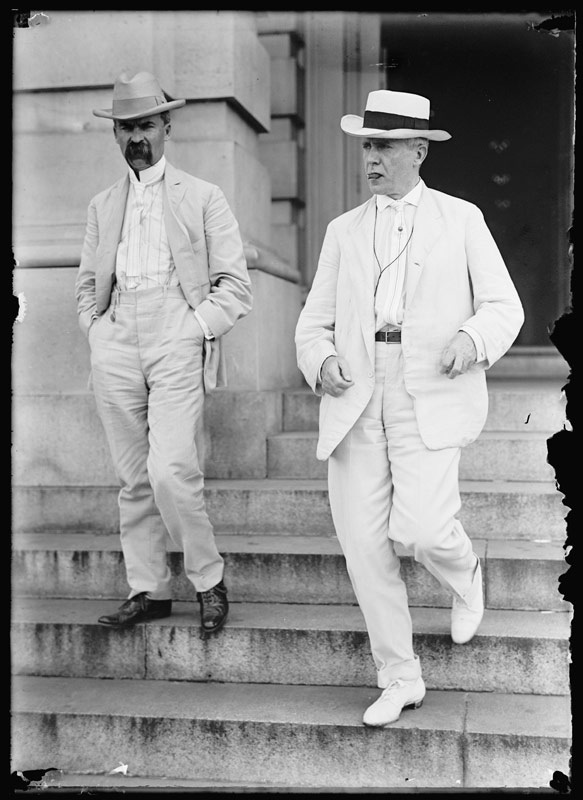
Legendary Missouri politician and attorney for the Snyder family in this lawsuit was James A. Reed, a distinguished former U.S. Senator. In what Time magazine characterized in 1927 as a forest of competing “presidential timber”, he was Missouri’s “tough-fibred, silver-topped sycamore, U. S. Senator James A. Reed” Read more: http://www.time.com/time/magazine/article/0,9171,736900,00.html#ixzz2QTHc0uU8
Reed was one of the rare politicians who got on H. L. Mencken’s good side. When Reed retired from the Senate, Mencken saluted him: http://www.truthbasedlogic.com/ownman.htm
The “Fighting Senator from Missouri” was also paramour (and later husband) to Nellie Don, a Kansas City legend in her own right as founder of one of the largest dress manufacturing companies of the first half of the 20th century.
It is perhaps an understatement to say that our research led us to a cast of very interesting characters whose lives touched the Osage River.
Tuesday, May 19, 2015
FACES LIKE DEVILS: The Bald Knobber Vigilantes in the Ozarks
Saturday, May 2, 2015
MOUNT IRISH WILDERNESS, Nevada, and new WILDERNESS IN COUNTY MAYO
An Taoiseach Enda Kenny TD, photographed at Néifinn Fhiáin in North Co. Mayo with from Left to Right Mr. Jimmy Deenihan, Minister for Arts, Heritage and the Gaeltacht, Dennis Strong National Parks & wildlife Services, and Bill Murphy, Head of Recreation Coillte to mark the signing of a Memorandum of Understanding (MoU) between Coillte and the Department of Arts, Heritage and the Gaeltacht that designates 11,000 HA along the Nephin Mountain Range as Ireland’s first wilderness area. March 14, 2013
(Images released by Ken Wright Photography)
Friday, March 20, 2015
OSCEOLA Book Signing
Many thanks to Larry Lewis of Osceola for arranging our presentation to the St. Clair County Historical Society last week. With Larry’s recommendation and the support of Angie Jones, Director of the St. Clair County Library, we were invited to discuss Damming the Osage with the members of the Historical Society. The town of Osceola and much of St. Clair County were deeply affected by the changes brought on by the construction of Truman Dam and Reservoir. Leland was a plaintiff in the lawsuit filed by the Environmental Defense Fund (1972) to stop or reduce the size and impact of the dam. It was a position that put him (then) at odds with many people in at least three, maybe four counties. Feelings were strong during the lawsuit. People took sides with strong opinions. We were curious to see what the reaction was to our description of events.
The gathering was cordial and the audience knowledgeable about the events and issues. Indeed, we learned a lot from them. Personal stories of life on the Osage River pre-dam, paddlefish season, the Civil War and its aftermath, outlaws and their final resting places, and meteors (that’s another post!) were lively, informative and added an intimate perspective on the costs and consequences of such huge and intrusive projects.
We showed our book video and one titled Osceola’s Lament evoking the after-dam realization that reality doesn’t begin to meet the optimistic promises of the dam-builders and promoters. Sadly, many of the negative consequences predicted by that lawsuit seem to have come to pass. Today, many residents are unenthusiastic about the monstrous and shallow reservoir that destroyed so much of the history and natural resources of the area.
Many thanks to Jim Arnett of Leawood, Kansas for taking the photographs. (click on any photo to enlarge and start slide show)
OSCEOLA Book Signing
Monday, March 16, 2015
KANSAS CITY STAR - 53 years ago today - CORPS RECOMMENDS ADDING POWER GENERATION TO KAYSINGER BLUFF DAM
Twelve years after authorization of what was then called Kaysinger Dam, and a little more than two years before the actual groundbreaking commencement of construction, Army Corps of Engineers Lt. Gen. W. K. Wilson, Jr. recommended to the Secretary of the Army the addition of power generators and a larger conservation pool to the already massive project. Senator Stuart Symington was also informed of the recommendation.The Star notes this will make the reservoir larger than Lake of the Ozarks.
Not surprising – the cost was creeping up. Read all about it! KCStar_03.16.62
KANSAS CITY STAR - 53 years ago today - CORPS RECOMMENDS ADDING POWER GENERATION TO KAYSINGER BLUFF DAM
Wednesday, February 18, 2015
JOHN HOGAN’S THIRD RECON TRIP TO THE OZARKS – January to March 1858
REV. William Walsh, the devoted zealous pastor of St. Peter's church, Jefferson City, ever a loving faithful friend of the emigrant, took the greatest possible interest in every effort made to lead the good Catholic Irish people from the railroad shanties and the back streets and cellars of the cities, to locate them on lands. With this purpose in view, he offered to accompany me on my next journey into southern Missouri, so that having knowledge of the country and of the progress of the undertaking in which I was interested, he could aid me, if in his power, to do so.
We set out from St. Louis together in the last days of January, 1858. Traveling on the Iron Mountain Railroad to its southern terminus, then somewhere in Washington County, we thence proceeded on horseback, following somewhat, but diverging more southerly from, the route taken by Reverend Father Fox and myself a short time previous. At Van Buren we found a Canadian named Ronge, a Catholic, whose three children I baptized. Going eastward from there we crossed the Black River at its junction with Brushy Creek. Reverend Father Walsh when crossing the river, although keeping his feet raised as high as possible along the horse’s sides, still could not keep them entirely out of the water, which was deep and very cold, it being freezing weather at the time. The result was bad for the dear Reverend Father. The only change of clothing which we had was a pair of socks, which he put on instead of the wet ones. These did not save him. The cold wet boots and the wet frozen clothing brought on a chill, which was soon followed by coughing, and fever. Next, the flushed face and the short, difficult breathing with other symptoms of pneumonia, came on apace.
We diverged from our intended course and made by the shortest way for Greenville, the county seat of Wayne County, where we hoped to find some kind of hotel accommodation. For some days the dear Reverend Father lay in danger of death, in a poor uncomfortable tavern, and under the care of an unskilful physician. Soon, however, he began to recover and by degrees grew better so as to be past all danger, for which merciful favor I was most grateful to Almighty God. During his convalescence I made a journey to Jackson in Cape Girardeau County, to employ an agent near the Land Office there, to transact business for the settlers. Returned to Greenville, I was glad to find my dear reverend friend in much better health and courage than when I had left him. We again set out together and rode by easy stages towards the Iron Mountain and Potosi, thence homeward by rail to St. Louis; he going to Jefferson City and I to Chillicothe.